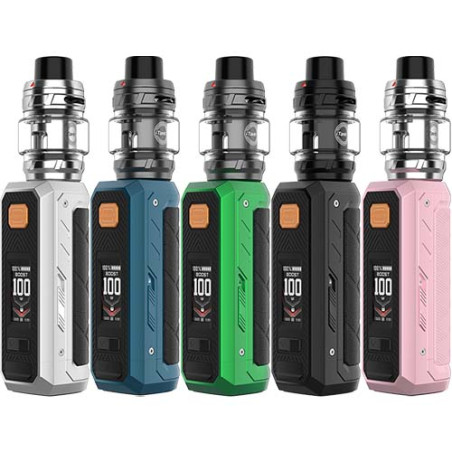
An e-cigarette uses a battery to heat e-liquid in a coil. The liquid is carried to the heating element through a wick, often made of cotton. When the liquid is heated, an aerosol is formed and carried through the mouthpiece when you take a puff. The aerosol is commonly called vapour, but it is not just water vapour.

How is an e-cigarette constructed?
The three central parts are the battery unit, the e-liquid reservoir and the coil. Design, size and power vary between models. In some devices, the tank and coil are separate parts; in others, the coil is built into a pod.
Heating starts with a button or a sensor that detects inhalation. Air passes by the coil and carries the aerosol through the mouthpiece.
The battery and battery unit
The battery stores the energy that powers the heating element. A mod is the battery unit itself, with space for the battery and, in regulated models, electronics that control the power. Batteries are available in different sizes and with different capacities. A built-in battery is fixed inside the device, while a model with replaceable batteries has a battery compartment.
On rechargeable models with a built-in battery, charging takes place via the device's charging port, often USB. The built-in battery should not be removed. Replaceable batteries can be charged in a compatible external charger; some devices also support charging with the battery installed. Innokin Kroma-R is an example that supports both USB charging and separate battery charging.
A USB cable is included in some packages. For example, the Vaporesso XROS 6 package contains a USB-C cable according to the manufacturer's packing list. This does not mean that a power adapter is included.
Use batteries and charging equipment intended for the device. Charge under supervision while you are awake. Do not use damaged batteries or cables, and store loose batteries in a protective battery case so that the terminals cannot come into contact with keys or coins. Stop using and charging the device in the event of unusual heat, swelling or leakage. More charging advice is available in our guide on how to charge an e-cigarette.
The tank or pod
The tank or pod stores the e-liquid and carries it to the coil. Capacity is stated in millilitres (ml), for example 2 ml, 3 ml or 5 ml. Manufacturers may have different capacities for different markets: XROS 6 has a standard 3 ml pod and a 2 ml TPD version.
The tank's diameter is stated in millimetres (mm). The Vaporesso NRG PE, for example, is 25 mm in diameter. The diameter describes the tank's width, not how much liquid it holds.
Many standalone tanks are screwed onto the battery unit using a 510 thread. Pods instead often have a connection that fits a particular model or series. When changing tanks, both the connection and physical size must fit the device. The device must also support the coil's resistance and intended power; a 510 thread alone is not enough for the parts to work together.
The filling port and the way it is opened vary between tanks and pods. Our guide on how to refill an e-cigarette describes refilling.
The coil and wick
The coil contains a heating element made of metal wire or metal mesh, also called mesh. A wick, often made of cotton, soaks up the e-liquid and carries it to the heating element. In many tanks, the coil is replaced separately. In pods with a fixed coil, the entire pod is replaced when the coil is used up.
The wick needs to be saturated with liquid when the heating element is used. A low liquid level or insufficient liquid supply can cause the wick to overheat and produce a burnt taste. Stop using the device if it tastes burnt. A finished coil or pod with a burnt wick needs to be replaced. More liquid will not repair a wick that is already burnt. Also read our tips for avoiding burnt coils.
The coil's electrical resistance is measured in ohms (Ω). Resistance below 1 ohm is called sub-ohm. How much aerosol the device produces and how much e-liquid it consumes also depends on the power, airflow, coil design and how it is used. A lower resistance therefore does not automatically mean more aerosol or higher liquid consumption.
MTL means mouth to lung: the aerosol is first drawn into the mouth and then into the lungs. DTL means that it is drawn directly into the lungs. MTL occurs both below and above 1 ohm. XROS 6 is, for example, an MTL system with 0.6 and 0.8 ohm pods. Our guide explains the difference between MTL and DTL.
E-cigarettes, nicotine and quitting smoking
E-cigarettes heat liquid without burning tobacco. However, use is not risk-free, and nicotine is highly addictive. If you do not use e-cigarettes or nicotine, you should not start. Keep devices and e-liquid out of reach of children.
E-cigarettes are not approved smoking-cessation medicines in Sweden. For those who want to quit smoking, counselling and approved medicines are available. Support can be obtained through your local health centre or the Quit Smoking Line.
More about the parts and maintenance is available in our guide to e-cigarette parts and maintenance. Our guide on which e-liquid to choose explains the liquid's properties and compatibility. If you have questions about your device, you can contact us at support@cigge.se or 0243-202014.
Quick Facts
- Reading Time
- 5 min
- Popularity
- Very Popular
- Category
- Vape
- Published
- 2020-12-07
Related Products
Products mentioned in this article