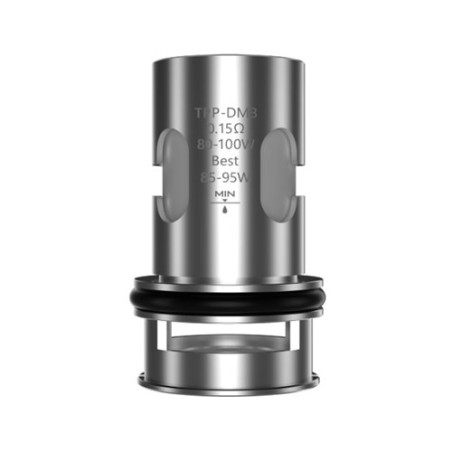
Sub-ohm means that the coil’s electrical resistance is lower than 1 ohm (Ω). Both 0.15 Ω and 0.3 Ω are examples of sub-ohm coils. However, resistance alone does not indicate which power setting, e-liquid or airflow is suitable.
Coil resistance and power
Resistance is measured in ohms and power in watts. Together with the coil’s construction, liquid supply and airflow, they affect how the e-liquid is heated.
How does the coil’s construction affect resistance?
Resistance depends on the wire’s material, length, thickness and temperature. With the same material and length, a thicker wire gives lower resistance. A longer wire gives higher resistance when the material and thickness are the same. The surface area that heats the liquid is a different characteristic from the wire’s thickness.
At the same voltage, lower resistance produces a higher current through the coil. In a regulated mod, the electronics adjust the voltage according to the set power. Therefore, the battery load cannot be determined solely from the coil’s ohm rating.
A mesh coil has a mesh or perforated metal strip as its heating element. This construction can distribute heat over a large surface area. How much aerosol is produced also depends on power, airflow and how well the wick receives liquid.
What does watt mean?
Watt (W) is a measure of electrical power: how much energy is supplied per second. Higher power supplies more energy to the coil over the same period. The power must be within the coil’s specified operating range; if the liquid supply cannot keep up, the wick may become dry and produce a burnt taste. Stop using the device if it tastes burnt.
Higher power normally consumes more battery energy for puffs of the same length and number. However, not all coils under 1 ohm require high power. The coil construction determines the applicable power range.
Tanks, RTA and RDA
There are tanks with ready-made replacement coils and constructions where the user installs the coil and wick themselves. All three types can be used with resistance below 1 ohm when the parts are intended for this.
Tank with replacement coils
A sub-ohm tank uses coils under 1 ohm from the coil series that fits the tank. The Vaporesso NRG S Tank is an example and uses the GT series, also called GT Core. GTi, GTX and VooPoo TPP are other coil series and do not fit as replacements in the NRG S.
Rebuildable Tank Atomizer (RTA)
An RTA has a liquid reservoir and a build deck where the user installs the coil and wick. The liquid is fed from the reservoir to the wick. The resistance can be above or below 1 ohm depending on the construction.
Rebuildable Dripping Atomizer (RDA)
An RDA also has a build deck for the coil and wick, but the liquid is supplied directly to the wick, usually by dripping. An RDA can also have resistance above or below 1 ohm. Both RTAs and RDAs require knowledge of coil installation, resistance and short-circuit checks before use.
Which e-cigarette works with a sub-ohm coil?
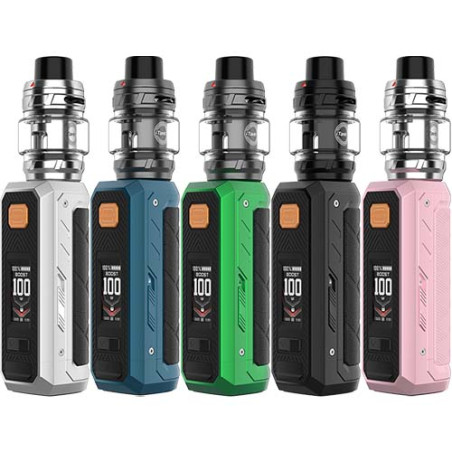
The tank, coil and battery device must be compatible. The coil must fit the tank’s coil series, the tank’s connection must fit the battery device, and the device must support the coil’s resistance and power range. A mod with a high maximum power does not automatically meet the other requirements.
The included coil’s markings specify its resistance and recommended power range. Another coil in the same series may have different values. Do not use the same power setting for a replacement coil without first comparing the markings.
Battery safety when using sub-ohm
Use only batteries of the type and with the discharge capability required by the battery device. In a regulated mod, the battery current is affected by the selected power, battery voltage and the efficiency of the electronics. The current from the battery is therefore not necessarily the same as the current through the coil.
Do not use damaged batteries or loose batteries with torn plastic wraps or damaged insulation. Store loose batteries in a battery case where the terminals are protected against short circuits. Charge with compatible equipment while you are awake and at home. Do not attempt to bypass the device’s short-circuit protection or low-resistance warning.
Which e-liquid is suitable?
The thickness of the e-liquid needs to suit the coil’s liquid supply. A blend of 70 percent VG and 30 percent PG is common in larger coils for direct-to-lung inhalation, where the liquid openings are designed for more viscous liquids. Smaller coils for MTL may require a more free-flowing blend even when the resistance is below 1 ohm.
We have shortfill in our range. Shortfill is e-liquid in a bottle with space for an additive.
What is VG?
VG stands for vegetable glycerin, also called glycerol. It is more viscous than PG. A higher VG content generally makes the liquid thicker. If the liquid is too thick for the coil’s liquid supply, the wick may receive too little liquid and produce a burnt taste.
What is PG?
PG stands for propylene glycol and is more free-flowing than VG. PG can produce a more noticeable sensation in the throat, often called throat hit. Nicotine, flavourings and heating also affect the throat sensation. Stop using the device if your throat becomes irritated.
Nicotine in e-liquid
Nicotine concentration is stated in mg/ml, but this alone does not indicate how much nicotine is carried in the aerosol. Power, the amount of liquid vaporised and the length of puffs also play a role. A lower concentration therefore does not automatically mean less nicotine per puff in a device that vaporises more liquid.
There is no nicotine strength that suits all coils under 1 ohm. Resistance alone is not enough to use as a basis for choosing strength. Nicotine is highly addictive. Keep e-liquid out of the reach of children.
Vapour production, flavour and consumption
A construction with higher power and greater airflow can vaporise more liquid and produce more aerosol, often called vapour. Flavour and throat sensation are also affected by flavourings, the liquid’s composition, temperature and airflow. The amount of aerosol is not a measure of flavour quality.
| Characteristic | What affects it? |
|---|---|
| Vapour production | The coil’s construction, power, airflow and liquid supply. |
| Liquid and battery consumption | Set power as well as the length and number of puffs affect the consumption of e-liquid and battery energy. |
| Coil lifespan | The liquid’s composition, power and how well the wick is kept moist affect when the coil needs to be replaced. |
| Cost | E-liquid, replacement coils, charging and equipment are included in the cost. The ohm rating alone does not determine the cost of use. |
How does sub-ohm differ from MTL?
Sub-ohm describes the resistance. MTL, mouth-to-lung, describes drawing the aerosol into the mouth first and then into the lungs. DTL, direct-to-lung, means inhaling directly into the lungs. There are also MTL coils with resistance below 1 ohm.
MTL devices usually have tighter airflow, with a draw resistance that can resemble that of a cigarette, and often produce less aerosol than more open DTL constructions. When choosing components, the inhalation method, coil resistance, power range and liquid thickness therefore all need to match.
Quick Facts
- Reading Time
- 6 min
- Popularity
- Very Popular
- Category
- Vape
- Published
- 2020-09-18
Related Products
Products mentioned in this article