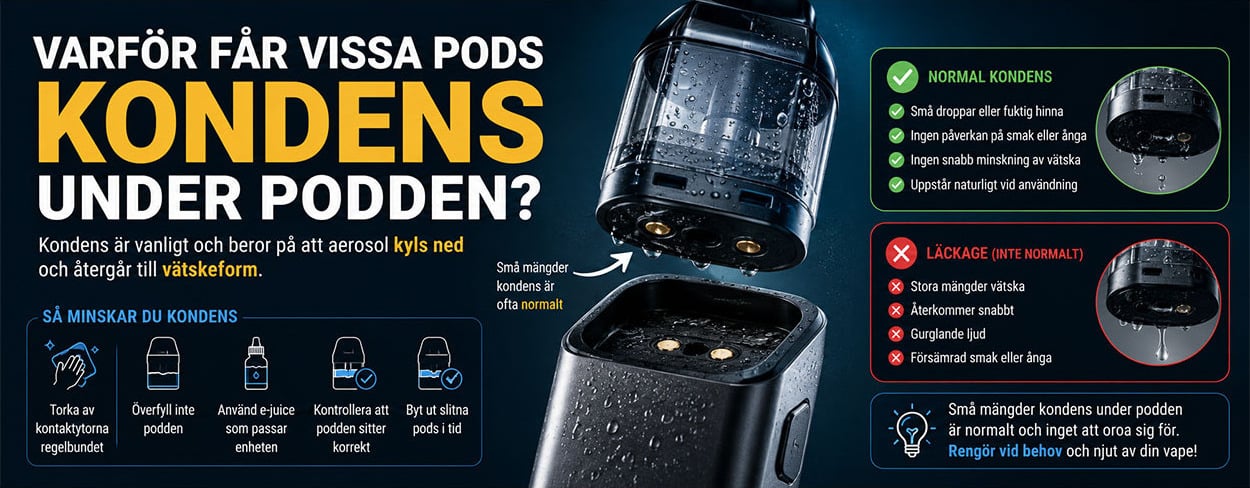
Condensation can form when the gaseous parts of the aerosol cool and its droplets stick in the airway. The liquid can then reach the underside of the pod. Leakage can produce similar droplets, so keep contact surfaces dry and stop use in the event of recurring accumulation or malfunction.
What is meant by condensation under the pod?
The term refers to liquid that collects between the pod and the device from the aerosol flow. Gaseous components can condense as they cool, and already formed aerosol droplets can stick to surfaces and form a liquid film. The collected liquid is not automatically pure water.
Leakage from the container can look the same. Even small amounts need to be dealt with.
Liquid can become visible in different places depending on the design:
- On the underside of the pod.
- In the air channels.
- On accessible contact surfaces between the pod and device.
- In the mouthpiece.
Liquid can accumulate over several uses.
Why does condensation collect specifically under the pod?
The routing of the air channels, openings and the connection to the device affect where liquid becomes visible. Droplets in an air channel can move towards an opening and reach the base of the pod. Remaining gas and aerosol can also cool or deposit after an activation has ended.
The Aspire Flexus Pro manual states that condensation between the pod and the device should be wiped away.
What can small amounts of liquid under the pod mean?
Small droplets or a thin film may come from the aerosol flow, but leakage can also begin with small amounts.
Design and use affect the process:
- Automatic draw activation: the sensor starts heating during inhalation. The airflow is controlled by the model’s airway and any controls.
- Vaporization chamber: the shape of the chamber and channels affects the aerosol’s path.
- New pods: liquid can collect even in a new pod and should be handled in the same way.
- Frequent use: aerosol passes through the airway on more occasions.
- Longer or more frequent activations: affect aerosol production, feeding and cooling. Do not try to clear it with longer or harder draws.
Other changes in a new pod are covered in the article about why a new pod may feel different during the first few days.
The difference between condensation and leakage
Condensation and aerosol deposits are liquid that collects from the aerosol flow. Leakage is liquid that leaves the container through an unintended route, such as an unsealed closure, damage or overfeeding. Both processes can occur at the same time.
The following can occur with both condensation and minor leakage:
- Small amounts of liquid.
- A thin damp film.
- No clearly visible change in the liquid level.
- Perceived normal taste and function.
Stop use in the event of recurring liquid or functional problems, such as:
- Larger amounts of liquid under the pod.
- New accumulation that returns quickly.
- A clear decrease in the liquid level.
- Gurgling sounds or impaired function.
Liquid in the airway can be caused by more processes than leakage; this is explained further in the article about why e-juice sometimes ends up in the airflow channel. Recurring accumulation or malfunction should not be investigated by continued test activation.
Can e-juice affect the amount of condensation?
Yes. The composition affects the properties of the aerosol and how the liquid is fed to the coil. The amount under the pod also depends on the design and use.
The VG/PG ratio affects viscosity. Liquid that is too thin or too viscous can, in a particular design, cause overfeeding or insufficient feeding. Liquid that runs from the container is not automatically condensation.
Flavourings, sweeteners and nicotine concentration can affect the properties of the aerosol in the formulations examined. Liquid requirements for different models are listed in the article which e-liquid is suitable for different vapes.
How can condensation under the pod be reduced?
Wipe liquid from accessible surfaces. Intended filling, a closed seal and correct assembly can help prevent excess liquid. An unsealed or damaged pod should be replaced.
- Contact surfaces: disconnect the charging cable, turn off the device and let it cool. Remove only the intended detachable pod. Wipe the pod base and accessible contact surfaces with a dry soft cloth. For the Innokin Sceptre, dry cleaning of the connection is specified.
- Filling: applies only to intended refillable pods. The Flexus Pro has a silicone seal on the side that is opened for filling and closed afterwards. Do not overfill the pod and keep the filling opening separate from the air channel. Sealed, pre-filled pods should not be opened or filled with your own liquid.
- Liquid feeding: the mixture should be suitable for the pod’s feeding system and materials.
- Assembly: the pod should have the intended fit and the seal should be closed. A mismatched part should not be forced into place.
- Replacement part: replace a cracked pod or a part with a damaged seal. A worn coil is replaced separately where the design allows it.
- Accumulation: liquid should not be left on accessible contact surfaces. In the event of recurring liquid or malfunction, stop use.
The contacts should be dry before reassembly. Do not rinse or open the battery unit, and do not bend or scrape the contact pins. The charging port and electronics must be kept dry. If liquid is suspected in the electronics, or there is unusual heat, damage, swelling or unintended activation, stop both use and charging. Do not test-charge or test-activate to see whether the problem has disappeared.
When should the pod be checked more closely?
Stop use in the event of recurring liquid, damage, an unstable fit or malfunction. The following symptoms may point to different parts of the problem:
- Larger amount of liquid: may be due to leakage or accumulation from aerosol.
- Gurgling: may be due to excess liquid or liquid from aerosol in the airway.
- Changed taste: has several possible causes. If the taste is dry or burnt, stop activation; burnt cotton cannot be restored by refilling.
- Weaker aerosol: may also be due to feeding, connection, power or battery function.
- Visible damage: a cracked pod or damaged seal should not continue to be used.
- Unstable pod: a mismatched or damaged part should not be pushed or forced into place for continued use.
The Aspire Flexus Pro has both a pod with a replaceable AF coil and a pod with a fixed coil. A worn AF coil is replaced as a coil module; in the version with a fixed coil, the pod section is replaced. Replace a damaged pod even if the AF coil can be removed. Wear and replacement designs are also covered in the article about how a pod wears over time and what affects its lifespan.
Quick Facts
- Reading Time
- 6 min
- Popularity
- Very Popular
- Category
- Troubleshooting & maintenance
- Published
- 2026-06-26
Related Products
Products mentioned in this article