

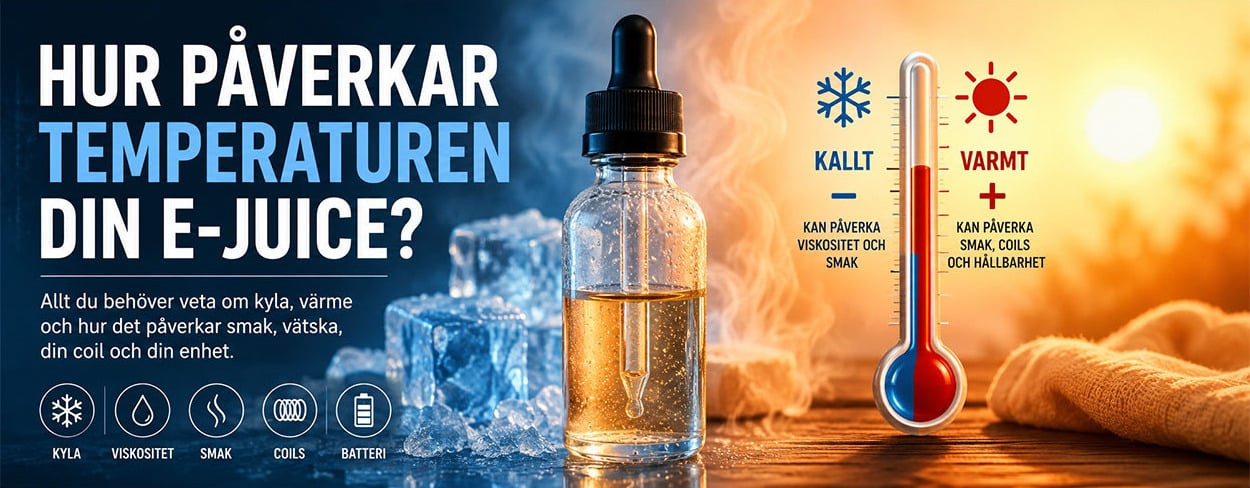
How does temperature affect your e-juice?
Cold normally increases the viscosity of e-liquid, making it more viscous. Heat decreases viscosity within the liquid range. This can change the transport through the wick to the coil. Storage can also alter the ingredients, and temperature affects the battery device through other mechanisms.
Why does e-juice react to temperature?
E-liquid usually contains propylene glycol, PG, glycerin, VG, flavorings and sometimes nicotine. Temperature changes the liquid’s resistance to flow. Glycerin is normally more viscous than PG under comparable conditions.
A higher VG content often produces a more viscous liquid than a higher PG content. Other ingredients and their proportions also affect flow.
What is viscosity?
Viscosity is resistance to flow. High viscosity means a more viscous liquid, while low viscosity means that it flows more easily. For PG/VG-based liquids, viscosity normally increases when cooled and decreases when heated within the liquid range.
How large the change is depends on the recipe and temperature range. Viscosity and freezing point are different properties.
How does cold affect e-juice?
Cold can make the liquid more viscous and reduce feeding to the coil. A high-VG blend may already be viscous at the starting temperature. If liquid consumption during activation exceeds the feed rate, the wick may become insufficiently saturated. Higher power or frequent activations will not solve that problem.
Allow an undamaged and closed bottle to reach room temperature naturally. Do not heat a bottle or battery device in a microwave, on a radiator or with another heat source.
Can e-juice freeze?
Freezing behavior depends on the blend; there is no single freezing point for all e-liquid. PG, VG and other ingredients affect how the blend behaves. A very viscous liquid is not the same as ice or crystal formation, and the liquid does not need to freeze like pure water.
Do not use contents from a leaking or damaged package. Do not taste-test unusual contents. Temperature equalization does not restore damage or chemical changes.
How does heat affect e-juice?
Heat normally decreases viscosity and can change liquid flow in a pod or tank. This is a different process from changes in the ingredients during storage.
The recipe, temperature, time, light and air contact affect how ingredients change during storage. Protect the bottle from direct sunlight, a hot car and heat sources.
Can high temperature increase the risk of leaking?
Yes. More free-flowing liquid can contribute to overfeeding or leaking. Seals, fit, filling and pressure conditions also have an impact.
Condensation instead forms through the cooling of the aerosol’s gaseous components. Aerosol droplets can also deposit in the airflow path. These processes can produce similar accumulations of liquid.
A device exposed to intense heat should not be test-activated to check the seal. In the event of abnormal heat, damage or suspected liquid in the electronics, both use and charging should be stopped.
Can heat affect the flavor?
Yes. Flavorings can change during storage, and heat can affect the process. How quickly this happens depends on the recipe and storage conditions. Taste tests should not be used to assess the condition of the liquid.
At the coil, a small film of liquid is heated and forms an aerosol. This is a different temperature process from storage in the bottle and can also change the chemical composition.
The device’s feeding and design can also affect observed flavor differences. The guide Why does the same e-juice taste different in different vapes? describes this issue in more detail.
Does temperature affect nicotine?
Temperature, storage time, light and oxygen can change the nicotine in a liquid. The change depends on the recipe and exposure; the current nicotine content can be determined through analysis.
Nicotine salt describes the form of nicotine, while mg/ml indicates the strength. Store the bottle sealed and protected from sunlight and heat.
Does e-juice become thicker in winter?
The liquid can become more viscous when the bottle, pod or tank is cooled. It is the temperature, not the season itself, that affects viscosity.
The draw can simultaneously be affected by the coil, power and battery level.
Can cold e-juice affect the coil?
Yes. Viscous liquid can reach the wick more slowly. If consumption exceeds the supply, the wick can become dry, overheat and be damaged.
Stop activating the device if there is a dry or burnt taste. Burnt cotton cannot be restored by refilling or heating. In a design with a fixed coil, replace the intended pod or tank section; in a design with a replaceable coil, use the correct compatible replacement part.
The guide Why does my coil turn black? describes discoloration, and How do you know which coil to use? explains compatibility.
Does temperature affect the battery in your vape?
Yes. The battery’s electrochemistry is affected by temperature, charge level and load. A regulated device can maintain the set power within its limits and then restrict or stop. Cold liquid and a cold battery should therefore be assessed as separate components.
Do not charge a very cold or hot battery device. In the event of swelling, damage, abnormal heat, unintended activation or suspected liquid in the electronics, both use and charging should be stopped. Do not test-charge or test-activate the device to see whether a fault disappears.
The guide What is the difference between an integrated battery and a replaceable battery in a vape? describes battery design and handling.
Are different types of e-juice affected to different degrees?
Yes, the composition affects the temperature response. The four product terms below, however, describe different properties:
- Nicotine salt: indicates the form of nicotine, not VG/PG content or the permitted device on its own.
- 10 ml e-liquid: indicates volume; the recipe and nicotine strength are separate details.
- Shortfills: describe a filling format with room for the intended additive, not a specific VG content.
- Longfill: is a format that is mixed before use; the composition of the finished blend is decisive.
A high VG content can produce a viscous liquid even in a shortfill. The blend’s actual composition determines its temperature response.
Innokin specifies 50 VG/50 PG and 70 VG/30 PG for Go-Z, primarily intended for MTL. For GoMax, at least 70 percent VG is specified. Go-Z’s polycarbonate tank can also be affected by certain flavor recipes.
Should you store e-juice in the refrigerator?
Store e-liquid in a cool, dark place, protected from heat. A refrigerator makes the liquid more viscous and does not provide a single shelf life for different recipes.
Vaporesso describes a cupboard or drawer, protection from direct sunlight and a tightly closed bottle. Use a dry storage location and keep the original packaging closed, out of sight and reach of children and animals.
Can you leave e-juice in the car?
Do not leave e-liquid or a battery device in a hot car. Heat can affect ingredients and damage the equipment. Cold storage in a car can instead make the liquid more viscous and affect battery performance.
Do not use damaged or leaking packaging. Do not try to assess unusual contents through taste-testing or activation.
The devices in the starter kits for e-cigarettes category have different feeding systems, battery designs and intended replaceable parts. None of these properties is determined solely by the liquid’s temperature.
Which liquid details belong to the product?
VG/PG, nicotine form, nicotine strength and flavor recipe describe the liquid. Feeding, tank material and power range describe the design in which it is intended to be used.
The brand pages for Liqua and Drifter collect e-liquid products, while Vaporesso covers e-cigarette equipment. The properties belong to the individual liquid or device model.
Quick Facts
- Reading Time
- 7 min
- Popularity
- Popular
- Category
- E-liquid & nicotine
- Published
- 2026-07-10