

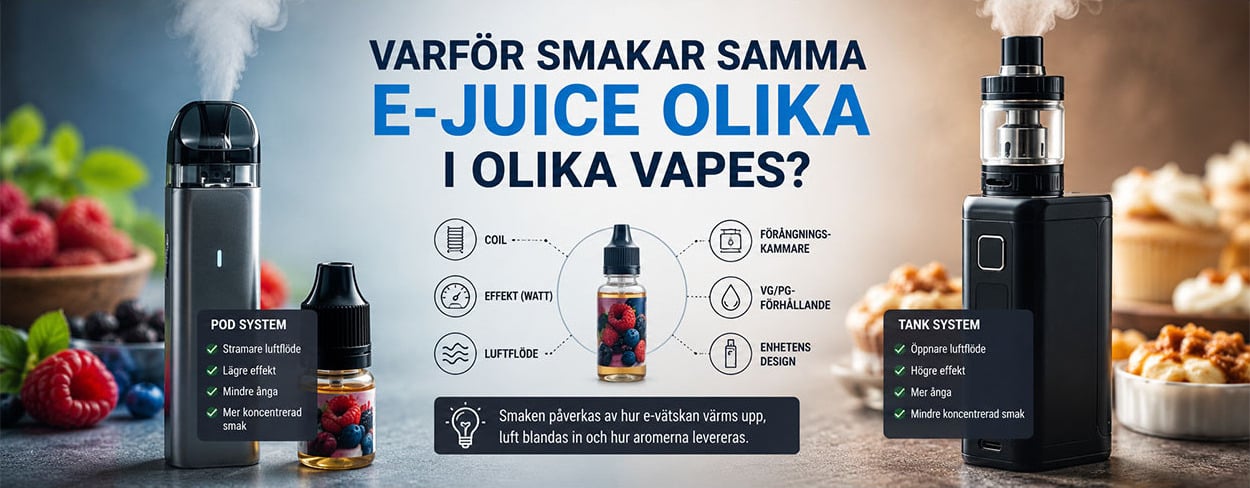
The same e-juice can be experienced differently when vapes differ in heating, airflow and liquid feeding. The coil's construction, power and the design of the pod or tank affect how the aerosol is formed and transported to the mouthpiece.
Liquid storage, residue from previous liquid and coil deposits can also change the taste. Stop activation if you experience a dry or burnt taste.
Why do different vapes affect the taste?
E-liquid is transported through the wick to an electrical heating element, the coil. During heating, aerosol forms, mixes with air and passes through the device. Differences in this process can affect how the flavours are perceived.
How does the coil's construction affect heating?
The coil's material, resistance, heating surface and contact with the wick affect how heat is supplied to the liquid. Two coils with the same resistance can have different surfaces and constructions and therefore work differently at the same wattage.
Mesh has a net-shaped or perforated heating element. A wire coil has a metal wire in a spiral. The material, dimensions and contact with the wick affect how the heat is distributed.
The guide on how to choose the right coil describes coil compatibility.
Wattage and temperature affect the flavours
Wattage indicates electrical power. Coil temperature also depends on the heating element, air cooling and liquid supply. The same wattage can therefore produce different heating in different constructions.
More supplied power can change aerosol production. Temperature control instead limits the power based on a calculated temperature limit.
A fruit-based liquid may be perceived differently under different operating conditions, but the flavour name does not indicate a suitable wattage. Excessive power in relation to the coil's construction and liquid supply can overheat the wick. Stop activation if you experience a dry or burnt taste.
The article about wattage, volts and puff counters in a vape explains what the device's values mean.
Airflow and aerosol in different devices
Airflow affects the cooling of the coil and how air mixes with the aerosol. The size of the openings and the design of the air channels also affect draw resistance.
When the amount of air changes, aerosol production can also change. Therefore, the difference in taste depends on both airflow and heating.
The design of the vaporisation chamber and the aerosol's path
The vaporisation chamber is the space around the heating element where the aerosol forms before continuing towards the mouthpiece. The chamber's volume, the placement of the air openings and the distance to the mouthpiece are part of this path.
Two devices with similar coils and wattage can have different air channels and distances to the mouthpiece. The chamber volume is part of the entire transport path.
The guide on open and closed pod systems describes differences in construction and filling.
MTL and DTL: inhalation methods and construction
MTL means mouth-to-lung: the aerosol first passes through the mouth and then the lungs. DTL means direct-to-lung. The terms describe inhalation methods and are not two fixed resistance or wattage classes.
MTL constructions may have a tighter airflow and lower power. DTL constructions may have a more open airflow and higher power. These construction differences affect how the aerosol forms and cools.
The guide on the difference between MTL and DTL explains the terms.
VG and PG affect how e-liquid works
E-juice may contain vegetable glycerin (VG), propylene glycol (PG), flavours and nicotine. The PG/VG ratios affect consistency, but other ingredients and temperature also affect the flow of the finished mixture.
- Higher PG content: produces a thinner mixture when the other ingredients and conditions are comparable.
- Higher VG content: produces a thicker mixture under comparable conditions.
The liquid needs to be able to reach the wick. Innokin specifies both 50VG/50PG and 70VG/30PG for Go-Z, while GoMax is specified for at least 70 percent VG.
Material compatibility also matters; the correct VG/PG ratio does not mean that every flavour recipe suits every tank material. The article about VG/PG ratios describes the base ingredients in e-juice.
Why can fruit, dessert and mint flavours be perceived differently?
Fruit, dessert and mint names describe different flavour profiles. The substances and concentrations in recipes can differ even within the same profile.
- Fruit: the flavour blend affects which fruit nuances are noticeable.
- Dessert and cream: profiles that can be based on different combinations of flavouring substances.
- Mint and menthol: the cooling sensation depends on the recipe and the conditions during aerosol formation.
The flavour name does not indicate a wattage setting. A mild or intense flavour is also not a measure of nicotine exposure or safety.
A new coil or pod may taste different
A new refillable coil or pod needs a saturated wick before activation. A used part may have deposits and residue from previous liquid that affect the taste.
For the Aspire Flexus Pro, the manufacturer specifies at least five minutes after filling. Sealed, pre-filled pods should be kept closed and must not be primed by the user.
Stop activation if you experience a dry or burnt taste. Burnt cotton cannot be restored by taking more puffs or refilling. A replaceable coil should be replaced with the correct compatible part; when the coil is fixed, the entire intended pod or tank component should be replaced. Weak or uneven flavour alone does not show which component is faulty.
Do not use or charge a damaged, unusually hot or self-activating device, or a device suspected of having liquid in its electronics. Do not charge or activate it as a test to investigate the fault. The article about why a new pod may feel different during the first few days distinguishes initial use from signs of a fault.
How does the age of the coil affect the taste?
Ingredients can leave deposits on the heating surface during use. These can affect feeding and heating, so the flavour may seem dull or changed even when the same liquid is used.
Deposits accumulate on the material, while dry heating can damage the wick. A sweet taste does not show which sweetener the liquid contains.
There is no common replacement interval for all coils, and cleaning does not always restore function. The article about why a coil turns black describes deposits and discolouration.
Example: the same e-juice in two different vapes
A hypothetical comparison using the same fruit-based liquid could include two constructions:
- A pod with a 0.8-ohm coil, restricted airflow and a lower intended power range.
- Another device with a coil below 1 ohm, more open airflow and a higher intended power range.
0.8 ohm is also below 1 ohm and is considered sub-ohm. In the comparison, it is the airflow, power and feeding that distinguish the constructions.
Innokin specifies MTL and 15–18 W for the 0.8-ohm Z-Coil in the Zenith Minimal.
Different heating and transport paths can produce different flavour experiences with the same liquid.
Quick Facts
- Reading Time
- 6 min
- Popularity
- Very Popular
- Category
- E-liquid & nicotine
- Published
- 2026-06-25