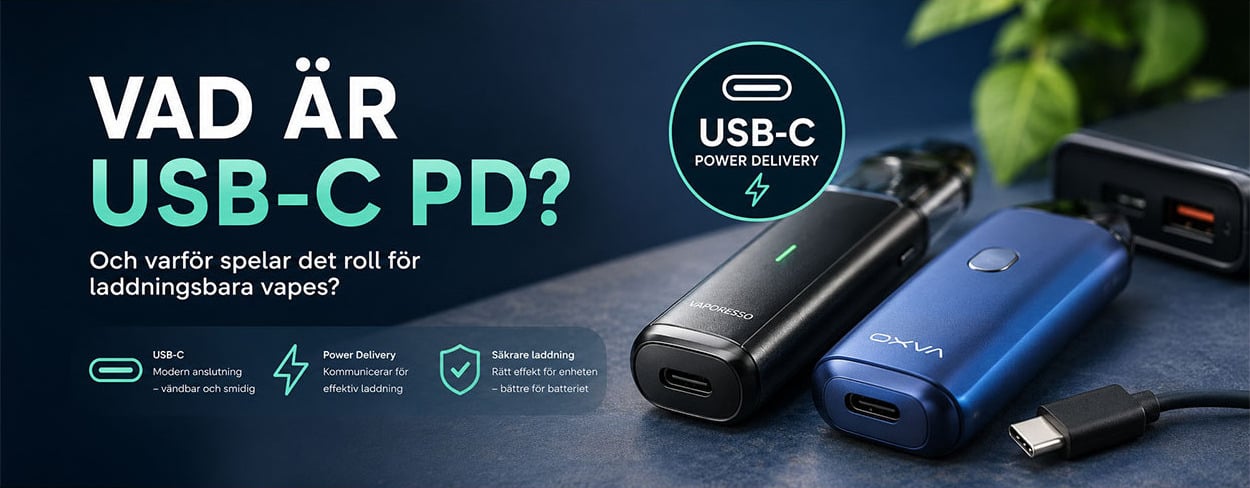
USB-C is the connector format. USB Power Delivery, abbreviated USB PD, is a separate protocol in which the power source and the device negotiate the power supply. A vape can have USB-C and charge at 5 V without using PD.
For rechargeable vapes, the port, charging input and battery capacity are different specifications.
What is USB-C on a vape?
On a rechargeable vape, USB-C is the port where a designated charging cable is connected. The USB-C connector is reversible, unlike, for example, USB Micro-B. The port supplies power to the charging electronics, which manage charging the battery.
USB-C is also found on prefilled pod kits. The battery, charging circuit and specified input values determine the charging conditions; the shape of the connector does not indicate charging speed.
What does USB-C Power Delivery mean?
Power Delivery means that the power source communicates which levels it offers and that a compatible device requests a supported level. A laptop and a small battery device therefore do not need to use the same amount of power from the same PD charger.
A standard-compliant USB-C power source can provide 5 V without a PD agreement. Higher PD voltage requires negotiation between the power source and the connected device.
Why does USB-C PD matter for vape batteries?
PD regulates the power supply at the USB input. The device’s internal charging circuit then controls the current to the battery and ends the charging process.
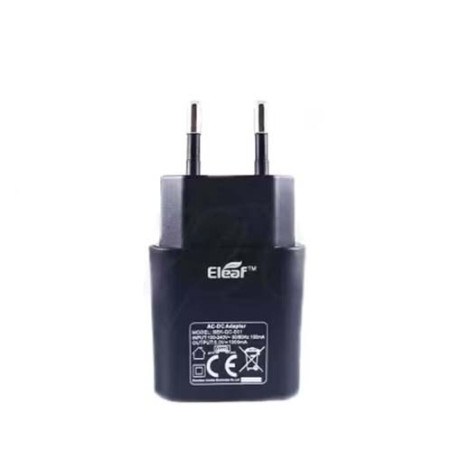
The charger’s maximum power is not automatically supplied to the device. An adapter with a higher current capacity also does not automatically force all of that current into the device. Voltage, available current, cable and connection function must match the device’s charging conditions.
Can you use any USB-C charger with a vape?
No. A matching connector is not enough: the device’s charging input, the power source’s output and the cable type must be compatible. The eight models below have specified charging at 5 V and either 1 A or 2 A. These values are not permission to supply 9 V.
USB-C-to-USB-C has the same connector format at both ends. USB-A-to-USB-C has USB-A at the power source. The cable type, input and power source need to match the intended connection.
5 V/1 A and 5 V/2 A describe voltage and current at the charging input, not the coil’s power. Do not use damaged equipment, loose connections or an adapter whose output and intended use cannot be established. Do not try to solve a failure to charge by forcing higher voltage or carrying out repeated charging tests.
A power bank is also a power source with its own outputs and protocols. The same distinction between port, cable and input applies there. The guide Can you use a power bank to charge your vape? describes that connection further.
Does a vape charge faster just because it has USB-C?
No. USB-C indicates the connector. The time to a full charge depends on several factors:
- Battery capacity and starting level: how much charge the battery needs to receive.
- Charging circuit: how the device regulates and ends the charging process.
- Specified input current: one of the limitations on the power supply.
- Charging protocol: any PD support and which levels are actually used.
- Charger and cable: the power supply the intended combination can provide.
Different capacities, charging circuits and starting levels result in different charging times.
How do you know if a vape has USB-C or USB-C PD?
USB-C identifies the port. PD support is a separate protocol specification from the manufacturer. Four types of labeling have different meanings:
- USB-C: connector format.
- 5 V/1 A or 5 V/2 A: specified voltage and current, when the information refers to the device’s input.
- USB PD or Power Delivery: an explicit statement about the protocol for the named model.
- 5 V/3 A and 9 V/2 A: examples of level labeling that do not alone identify the protocol.
The table below shows the 5 V inputs for eight models. The information concerns charging voltage and current. PD support is a separate specification.
USB-C charging in the eight models
All eight models have USB-C and specified charging at 5 V. The table shows the manufacturers’ charging specifications for the specific named models:
| Model | Port | Specified charging specification |
|---|---|---|
| OXVA NEXLIM Pod Vape Kit | USB-C | 5 V/2 A |
| OXVA Xlim GO 2 Pod Vape Kit | USB-C | 5 V/2 A |
| OXVA NEXLIM GO Pod Vape Kit | USB-C | 5 V/2 A |
| Vaporesso Vibe SE Pod Vape Kit | USB-C | 5 V/1 A |
| Vaporesso Vibe Pod Vape Kit | USB-C | 5 V/1 A |
| Vaporesso VIBE Nano Pro Pod Kit | USB-C | 5 V/2 A |
| Vaporesso ECO Nano Plus Vape Kit | USB-C | 5 V/2 A |
| Vaporesso Vibe Nano Pod Kit | USB-C | 5 V/1 A |
VIBE SE refers to the original model. VIBE SE 2, NEXLIM GO and VIBE Nano Pro are different models from VIBE SE, NEXLIM and VIBE Nano. Nano Pro has a display.
The models use pods that connect to the battery unit. Pod compatibility and the battery’s charging input are separate properties.
Here you can find our starter kits for e-cigarettes and the products from OXVA and Vaporesso.
USB-C on a vape compared with a disposable vape
Rechargeability and disposable format are different design characteristics. A disposable vape may be intended for battery charging while still having a sealed, prefilled liquid section. Charging does not replenish the liquid or restore a used-up or burnt coil.
A pod system or other vape kit may instead have intended replaceable pods, coils or cartridges and be designed for repeated battery charging. Which parts can be filled or replaced is a feature of the model’s design, not a consequence of USB-C. A sealed disposable product should not be opened for filling or battery replacement.
Common mistakes when charging a vape
Incorrect charging conditions or damaged equipment can cause charging problems. Avoid the following:
- Equating USB-C with fast charging. The connector does not indicate the protocol or the time to a full charge.
- Continuing to use a damaged cable or loose connection. Stop charging; do not bend connector pins or tamper with the port.
- Using a charger without a verifiable output. The adapter’s wattage alone does not show that it is an intended charging combination.
- Confusing specifications. The USB input, battery capacity and coil wattage are different pieces of information.
- Charging in heat, moisture or without supervision. Charge while you are awake, on a dry, stable surface with nothing flammable nearby. Do not cover the equipment or charge in a bed or on a sofa.
Disconnect the charger when the battery is fully charged. In the event of unusual heat, damage, swelling, accidental activation or suspected liquid in the electronics, stop both use and charging. Do not test-charge it to see whether a fault disappears. Do not open the battery unit or mains charger.
What does PD support say about charging?
PD is used to negotiate the power supply. Battery wear is affected by the cell, the actual charging profile, temperature and use.
The device’s charging circuit limits how much the battery receives. For the eight models in the table, 5 V is specified; their input should not be supplied with 9 V.
Battery capacity and pod compatibility
Capacity indicates how much charge the battery can store. The pod and coil type determine which replacement parts fit:
- Battery capacity: mAh indicates electrical charge capacity, not a set usage time between charges.
- Charging port: USB-C indicates the connector format.
- Charging specification: for example, 5 V/1 A or 5 V/2 A at the device’s input.
- Pod and coil type: determines which parts are intended to be filled, used or replaced.
- Compatibility: applies to the named device and part series; it does not follow from the USB-C port or brand.
Quick Facts
- Reading Time
- 7 min
- Popularity
- Very Popular
- Category
- Vape
- Published
- 2026-07-07
Related Products
Products mentioned in this article