

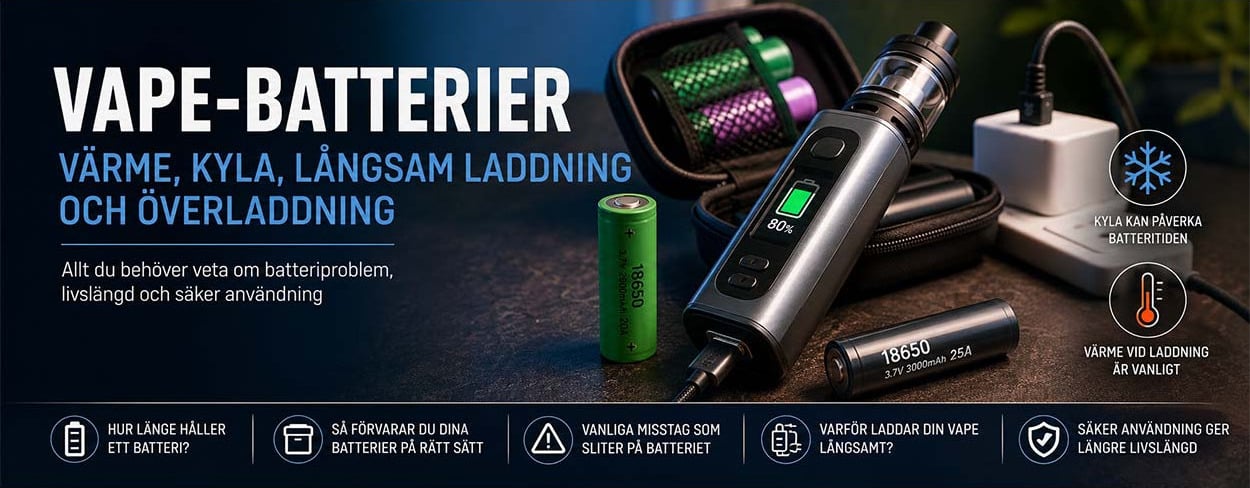
A vape battery can become somewhat warm while charging. Unusually intense heat, swelling, leakage or damage, however, are reasons to stop using and charging it. Cold can temporarily reduce battery life, while charging a cooled-down lithium-ion battery can damage it.
How does the battery in a vape work?
The battery supplies power to the coil, which heats the e-liquid and forms an aerosol. Lithium-ion batteries are also used in mobile phones, tablets, headphones and laptops.
Battery life is affected by capacity, set power, the coil's resistance, the duration and frequency of use, and temperature. The battery may be built-in or replaceable. A replaceable battery must meet the device's requirements regarding format and electrical properties. Our range includes vape batteries.
Why does my vape get hot while charging?
Some of the energy becomes heat when the battery is charging. The charging current, ambient temperature and heat from recent use affect how warm the device becomes. The charging speed may also change during charging, partly depending on the battery's charge level.
Stop charging if the device becomes unusually hot, continues to get hotter or feels uncomfortable to hold. A damaged cable or adapter must not be used. Abnormal heat may be due to a fault in the charging equipment, poor contact in the port, battery damage or an electronic fault.
Heat during use may also come from the coil and be affected by the wattage setting and repeated activations. Allow an unusually hot device to cool down, and do not use or charge it again if the heat returns. More information is available in My E-Cigarette Gets Hot – What Should I Do?. Fast charging requires support from the device and may affect heat generation; the subject is explained in Fast Charging and Vape Batteries.
The OXVA XLIM GO 2 has a temperature protection feature that, according to the manual, stops operation and displays five red flashes when the temperature is too high. That signal applies specifically to the GO 2. It does not remove the need to stop charging in the event of abnormal heat.
Can cold affect the battery in a vape?
Yes. Cold slows down the chemical processes in a lithium-ion battery. The battery may then provide shorter battery life and lower voltage under load. The device may provide lower power, charging may be limited and the battery indicator may show inconsistent values.
A temporary reduction in performance may disappear when the battery returns to room temperature. The voltage drop under load is called Battery Sag. A weaker battery is therefore not always defective, but persistent problems should not be dismissed as being caused by cold.
Do not charge immediately after significant cooling. Allow the device to reach room temperature naturally. Connect it only when the device is completely dry. Do not use a radiator or other direct heat source. Charging below freezing can cause metallic lithium deposits inside the battery and damage that increases the risk of a short circuit.
Why is my vape charging slowly?
Slow charging may be caused by the cable, the connection in the charging port, the power source's capacity, the temperature or an aged battery. Charging that repeatedly stops should not be continued by holding or bending the cable in a certain position.
Charging Cable and Charging Port
The conductors in a cable can be damaged even when the outside appears intact. Replace a cable that has a loose connection, is damaged or becomes abnormally hot. Dust and lint in the port can impair the connection. Disconnect the power before cleaning and avoid metal objects and liquids in the port. A loose or damaged port needs to be repaired; do not try to force the connector in.
Charger, USB Port and Power Bank
A power source that cannot deliver the current the device needs may result in slower charging. The shape of a USB port does not indicate which voltage, current or charging technology the device supports. The cable and adapter must match the device's charging specifications.
For example, the OXVA XLIM GO 2 has USB-C and a specified charging input of 5 V/2 A. That value applies to the model and is not a general charging rule for vapes. A higher maximum current rating on an adapter does not mean that it automatically forces the same current through the battery.
A power bank and a USB port may provide different charging speeds depending on the output and charging support. The same requirements for compatible equipment and supervised charging also apply there. Read more in Can You Use a Power Bank to Charge Your Vape?.
Battery Age and Load
An aged battery may store less energy and have higher internal resistance. This can result in shorter battery life, greater voltage drop and changed charging behavior. Slow charging alone, however, does not show that the battery is worn out.
C-rate indicates current in relation to the battery's capacity. For a 2 Ah battery, 1 C corresponds to a current of 2 A. The charging limit and permitted discharge current are different specifications. Neither can be calculated solely from the capacity without reference to the battery's specifications. More about the concept is available in C-rate in Vape Batteries.
Can a vape be overcharged?
Yes, overcharging can occur if charging is not limited as it should be and the battery's voltage becomes too high. The charging circuit in a rechargeable device regulates charging, but the protections provided vary between models. Electronic protection does not make a damaged battery or faulty charger safe.
Charge under supervision, on a hard surface with no flammable materials nearby, and unplug it after charging is complete. Avoid charging overnight while you sleep and charging in direct sunlight or a hot car. Do not connect an overheated device or damaged charging equipment. More charging advice is available in How to Charge Your E-Cigarette in the Best Way.
How long does a vape battery last?
There is no single lifespan in months or charging cycles for all vape batteries. Capacity decreases with age and use. Temperature, load, charging routines, charging equipment and storage affect the process.
A charging cycle corresponds to a total of 100 percent of the battery's capacity being used, not every time the cable is connected. Two instances of use where 50 percent is consumed each time together correspond to approximately one cycle.
Wear may be noticed as more frequent charging or the device losing power earlier with the same use. A battery that previously lasted a day may therefore need to be charged more often as it ages.
How should a vape battery be stored?
Store the battery in a dry place, protected from moisture, direct sunlight and extreme temperatures. Do not leave the device in a parked car, where the temperature can become high even when it is cooler outside. Store loose batteries in a battery case that protects the terminals.
For longer-term storage, the battery should not be left completely discharged. Lithium-ion batteries lose charge even when they are not being used, and deep discharge can make them unusable. Storage level and temperature limits are model-specific.
Repeated high heat can cause permanent capacity loss. Cold can temporarily reduce performance, but this does not make charging while cold safe. If you have several external batteries, labeling can help distinguish their age and use; batteries that are subjected to different loads may also wear differently.
Which mistakes damage or wear out the battery?
Direct sunlight, a hot car and recurring extreme temperatures can damage the battery. Damaged cables and visible battery damage are stop signs, not merely causes of shorter lifespan.
Lithium-ion batteries do not need to be completely drained before charging. Avoid leaving the device discharged for a long time. Do not charge immediately after use if the device is unusually hot. Uneven use of several external batteries can result in different wear; labeling does not replace the requirements for compatible batteries.
When should you stop using a battery?
Stop using and charging the battery if it swells, leaks, has an unusual smell, visible damage or intense heat. Smoke or fire requires you to leave the area, avoid the smoke and call 112.
| Symptom | Possible cause and action |
|---|---|
| The battery drains faster or loses power after charging | Wear, cold or changed load may be the cause. If the problem persists at room temperature and with the same use, the battery or device needs servicing or replacement. |
| Charging stops or is very slow | The cable, port, power source, temperature or battery fault may be the cause. Stop if there is a loose connection, damage or abnormal heat. Use an intact, compatible cable and adapter; persistent faults require servicing. |
| The indicator jumps, for example from 40 to 10 percent | Voltage drop or wear may affect the estimate. Such a jump is not a certain diagnosis. Persistent deviations require servicing, especially if they are accompanied by heat or charging faults. |
The battery's load and capacity are also explained in What Does C-rate Mean for Batteries and Why Does It Matter?. Take end-of-life external batteries to a battery collection point. A device with a built-in battery should be disposed of as electronic waste; do not attempt to remove the battery.
What is the difference between built-in and external batteries?
A vape with a built-in battery is usually charged via the device's USB port. The battery should not be removed by the user. A replaceable battery can be removed, but must be used with a compatible device and charger.
Never carry loose batteries together with keys or coins: metal can short-circuit the terminals. Use a battery case. Do not use a battery whose insulating wrap is damaged. Charging cables and battery cases are available among our e-cigarette accessories.
Quick Facts
- Reading Time
- 9 min
- Popularity
- Very Popular
- Category
- Troubleshooting & maintenance
- Published
- 2026-06-05
Related Products
Products mentioned in this article


