

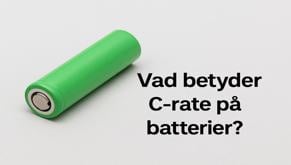
C-rate indicates current in relation to the battery’s capacity in ampere-hours. For 2500 mAh, or 2.5 Ah, 1C corresponds to a current of 2.5 A. Permitted charging current and discharge current are specified separately for the battery.
How is C-rate converted to amperes?
Current in A = C-rate × capacity in Ah. The same relationship can be written as I = C-rate × (mAh/1000).
1C theoretically corresponds to the reference capacity being discharged in one hour at a constant current. Actual operating time is affected by load, temperature and voltage limits.
The table is a mathematical conversion for a hypothetical 2500 mAh battery. It does not state any permitted maximum currents for an actual cell.
| Capacity | C-rate | Calculated current |
|---|---|---|
| 2500 mAh / 2.5 Ah | 1C | 2.5 A |
| 2500 mAh | 2C | 5 A |
| 2500 mAh | 5C | 12.5 A |
| 2500 mAh | 10C | 25 A |
What is the difference between continuous current and pulse current?
A continuous limit applies to ongoing load under the manufacturer’s conditions. A pulse rating applies to a short-term load and needs to specify, among other things, pulse duration, pauses and temperature. A brief activation does not make an undefined pulse rating useful as a battery limit.
Why does the current limit matter in an e-cigarette?
The battery’s current limit needs to match the device’s load. Excessive load can cause heat and voltage drop. Capacity in mAh indicates charge capacity; energy is stated in Wh and also depends on voltage.
P = V × I and I = P/V apply to power, voltage and current at the same electrical point. In a regulated device, the battery input must be distinguished from the coil output. Battery current is affected by output power, conversion losses, battery voltage, and the number and configuration of the cells.
60 W divided by 3.6–3.7 V gives approximately 16–17 A without conversion losses. This is an idealized calculation example, not battery selection advice. As battery voltage drops, more current may be needed for the same output power. The coil’s resistance is therefore not sufficient to determine battery current.
Which battery specifications need to match?
- Cell type and format: 18650, 20700 and 21700 describe cell formats. The device must support both the format and the cell’s electrical properties.
- Current limit: use an explicit limit with stated conditions, separate from the capacity in mAh. An industrial datasheet or well-known brand does not in itself make the cell intended for an e-cigarette.
- Origin: do not use cells of unknown origin or cells removed from battery packs.
- Charging: the charger should be intended for the cell type and its charging requirements. For 2.5 Ah, 0.5C mathematically corresponds to 1.25 A and 1C to 2.5 A; 0.5–1C is not a general charging range.
Is the C-rating the same for charging and discharging?
No, charging and discharging have separate current limits. The charging current may also decrease near full charge. How fast charging works describes the charging process.
How should the battery be handled?
Do not use or charge damaged cells. The protective wrap and insulating ring must be intact. Handle only cells that the device is designed for, and do not open integrated battery components or battery packs.
Transport removable cells in a protective case, separated from keys, coins and other metal objects. Charge with suitable equipment while you are awake and keeping watch, on a clean, level surface with no combustible materials nearby. Disconnect when fully charged.
Stop using and charging the battery in the event of abnormal heat, damage, swelling or suspected liquid in the electronics. Do not test-charge it to investigate a suspected fault. Rapid loss of capacity needs to be assessed; on its own, it does not identify a specific cell fault.
Quick Facts
- Reading Time
- 4 min
- Popularity
- Very Popular
- Category
- Vape
- Published
- 2025-11-03
Related Products
Products mentioned in this article


