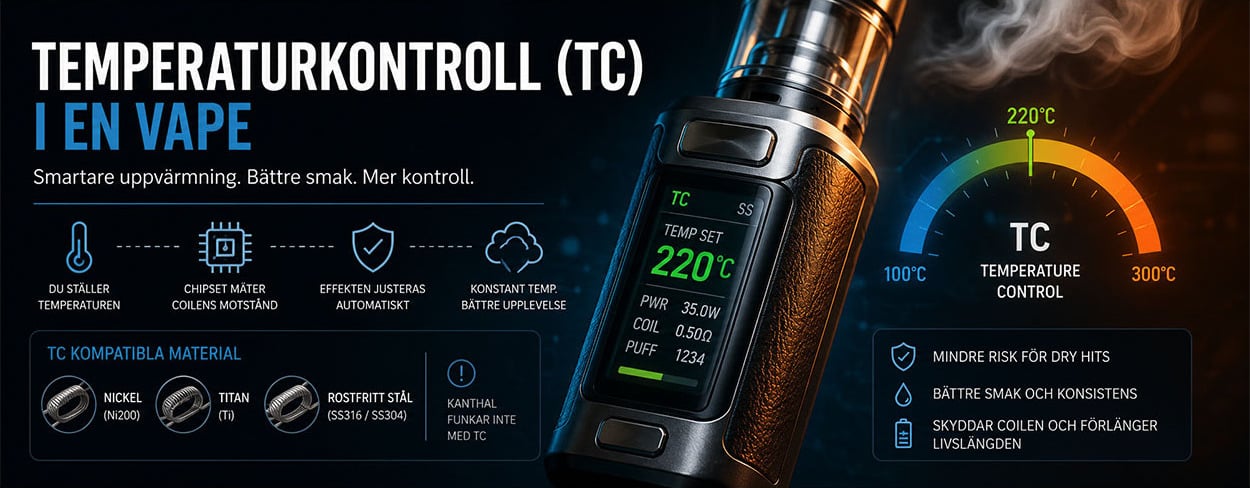
Temperature control (TC) is an operating mode that estimates the coil’s temperature from changes in its electrical resistance. The device regulates power toward a selected temperature limit. The function requires a chipset with TC support, a compatible coil and a material profile corresponding to the coil’s alloy.
TC is available on some mods and kits. The TC designation on a starter kit for e-cigarettes describes an operating mode; it does not mean that all coils that fit the tank work with temperature control.
How does temperature control work in a vape?
The chipset reads the coil’s electrical resistance during activation. A temperature-sensitive metal changes resistance when it heats up. With a material profile and a reference resistance, the electronics can calculate how the temperature has changed.
When the calculated temperature approaches the limit, the device can reduce power; when the coil cools, it can increase power within the limits of the operating mode. TC therefore requires both the right material and a correct reference. On the Evolv DNA60, a cold coil is used as the reference when a new atomizer is connected. A hot coil during that reading can result in an incorrect temperature calculation.
The DNA60 calculates an average coil temperature. Local temperature differences may exist; the liquid is not measured with a separate temperature sensor.
What is TCR and why is it mentioned together with TC?
TCR stands for Temperature Coefficient of Resistance. It describes how a material’s resistance changes with temperature and is used in the temperature calculation.
Nickel, titanium and different steel alloys have different properties. Therefore, a mod may have separate profiles for Ni, Ti and SS. The Eleaf iStick Pico 25 specifies TC modes for nickel, titanium and stainless steel, as well as the TCR memories M1, M2 and M3.
The TCR value should correspond to the alloy and the way the device specifies the coefficient. SS316 and SS304 have different properties. Some regulators use a material curve.
Which coils work with temperature control?
A coil must be made of a material for which the device’s TC function can calculate the temperature. It must also fit the tank or pod and be intended for the specific combination of device and operating mode.
- Nickel (Ni200): used with a profile intended for Ni200. The Pico 25 specifies this material for TC-Ni.
- Titanium (Ti): requires support for the correct titanium profile. The Pico 25 has a TC-Ti mode.
- Stainless steel (SS316/SS304): requires a profile for the specific type of steel. The Pico 25 specifies SS316 for its TC-SS mode. An SS coil may be intended for both wattage mode and TC, but this does not automatically apply to every type of steel, coil or device.
Kanthal changes resistance too little for the resistance-based TC function described here. A Kanthal coil intended for wattage mode does not become TC-compatible by selecting an Ni, Ti or SS mode.
Tank fit and TC support are therefore two different properties of vape coils. Neither mesh construction, resistance value in ohms nor a particular nicotine form proves TC compatibility.
The difference between wattage mode (VW) and temperature control (TC)
VW (Variable Wattage) regulates output power toward a selected wattage within the device’s operating limits. TC regulates power according to a calculated coil temperature and may also have a power limit. A wattage value does not correspond to any specific temperature.
| Wattage mode (VW) | Temperature control (TC) |
|---|---|
| Regulates power toward the selected wattage level. | Adjusts power according to the estimated coil temperature. |
| Requires a coil intended for the device and wattage mode. | Also requires a material and profile supported by the TC function. |
| Power is selected manually or controlled by the device’s preset. | Temperature limit and material profile are included; a power limit or TCR may also be available. |
| Available, for example, as VW mode on the Pico 25. | The Pico 25 specifies Ni/Ti/SS/TCR. The Armour Ultra specifies TC as an operating mode. |
| Intended handling depends on the construction of the coil and device. | Requires the material profile and reference resistance to be correct, regardless of the user’s experience. |
What does temperature control regulate during use?
TC can change the supplied power when the calculated coil temperature changes. The function affects heating but does not replace liquid delivery to the wick.
- Heating: power is regulated toward the selected temperature limit.
- Temperature limitation: the electronics reduce power when the calculated limit is reached.
- Dry wick: the temperature may rise and cause the power to decrease. Nevertheless, stop at signs of dry heating or a burnt taste.
- Selected temperature: the setting changes the temperature limit for the coil.
- More parameters: material profile, temperature and, on some models, a power limit or TCR are included in the regulation.
Coil, liquid supply, airflow and activation time affect heating.
What limitations does temperature control have?
The wrong coil material, material profile or reference resistance can result in an incorrect temperature calculation.
- Coil compatibility: not all coils have a material supported for TC.
- Model support: the electronics must have a TC mode.
- Material profile: the wrong profile provides an incorrect basis for the temperature calculation.
- Settings: TC may require more information than a selected wattage, including the material profile and cold reference.
- Pod systems and preset modes: automatic power or draw activation is not the same as TC. A device without TC does not become temperature-controlled through a different coil.
Is temperature control safe to use?
TC limits a calculated coil temperature. It is not a health-related safe temperature limit and does not show the temperature of the aerosol being inhaled.
An incorrect material profile, reference resistance or unsuitable coil can make the regulation inaccurate. TC does not replace protection against battery faults, short circuits or damaged components.
Stop activation if there is a burnt taste or signs of dry heating. Do not use or charge a device that is damaged, swollen, unusually hot, activates by itself or is suspected of having liquid in the electronics. Do not attempt to test the protection with an empty tank or dry wick.
Do you need to use temperature control?
No. TC is a specific operating mode and is not required for a device designed for wattage mode, automatic power or other preset modes. These functions can control power without calculating the coil temperature.
The material, profile and reference must be correct regardless of the user’s experience. An automatic power function has fewer settings and regulates in a different way.
Temperature control and operating modes in different models
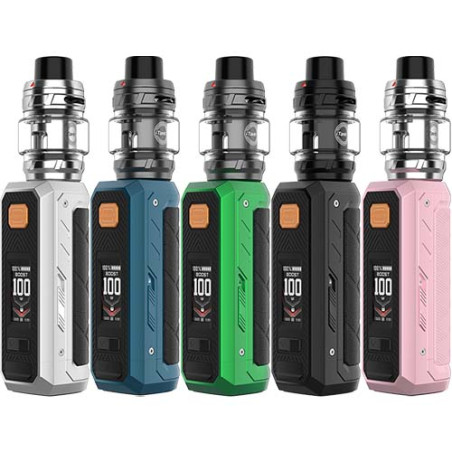
Vaporesso specifies TC, Pulse and Eco as operating modes for the Vaporesso Armour Ultra Vape Kit, which has an AXON chipset. The model’s TC support does not mean that the included GTi Dual Mesh coils are intended for that mode.
The Eleaf iStick Pico 25 has VW, Bypass, TC for Ni, Ti and SS, as well as TCR.
Operating modes differ between vape mods and between models from Vaporesso. A shared brand or chipset name does not mean that the models have the same features or coil compatibility.
How do you know if a vape has temperature control?
TC or Temperature Control in the model’s operating modes indicates temperature control. The following designations describe the function and material profiles:
- TC: abbreviation for temperature control.
- Temperature Control: the English term.
- TC Mode: designation for a TC operating mode.
- TCR: the material’s temperature coefficient; a TCR mode is used for the material parameter in the temperature calculation.
- Ni: nickel profile; the exact intended alloy must be specified.
- Ti: titanium profile.
- SS: stainless steel profile; the type of steel matters.
Does temperature control affect battery life?
Battery life depends on total energy consumption: supplied power, the length and number of activations, and the electronics. Capacity and battery condition determine the available energy.
TC can reduce power when the temperature limit is reached. The savings depend on the actual regulation and usage.
Charging is a separate feature. The guide on USB-C PD and rechargeable vapes explains the difference between the connector, charging voltage and charging protocol.
TC with nicotine salt and changing operating modes
Nicotine salt can be used with TC when the device and coil material support temperature control. The liquid must also be suitable for the coil’s liquid supply and material; the nicotine form does not control the temperature calculation.
A coil intended for both TC and wattage mode can be used in both modes on a device that supports them. The Pico 25 has both modes. Coils for Ni or Ti should only be used in the operating modes they are intended for.
Quick Facts
- Reading Time
- 8 min
- Popularity
- Popular
- Category
- Vape
- Published
- 2026-07-08
Related Products
Products mentioned in this article