

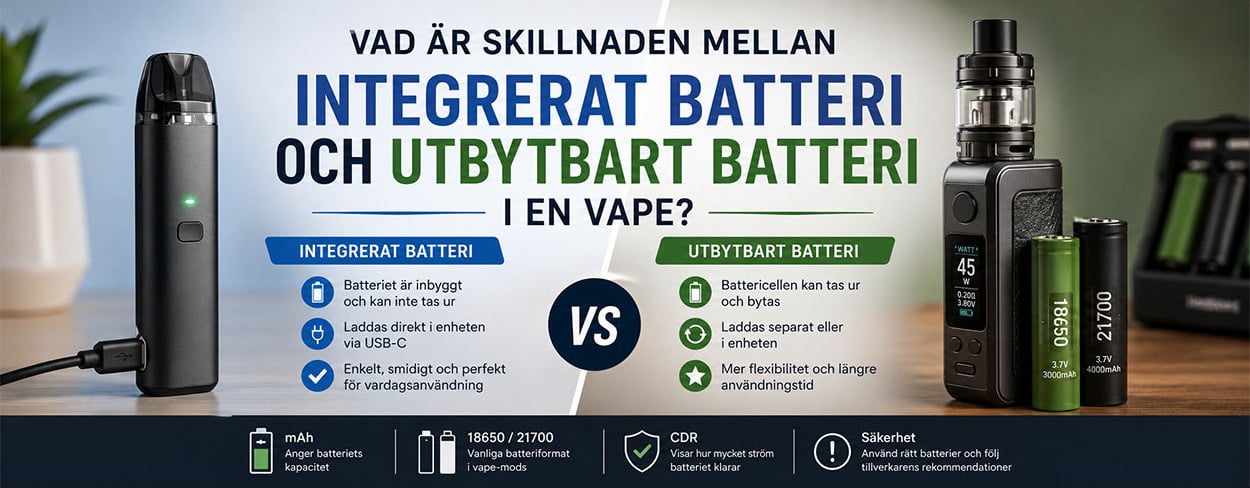
An integrated battery is built in without intended user replacement. A user-replaceable battery has a cover or module connection where the correct cell or battery pack can be removed and replaced.
Both designs can be found in devices with adjustable power. Battery access and its capacity are separate characteristics.
For example, the Vaporesso Armour Ultra has a built-in battery, while the Armour S has a battery cover for an intended loose cell. These are two different models. The fact that a product is listed among mods therefore does not mean that the battery is user-replaceable.
What is an integrated battery?
An integrated battery is mounted in the device without an intended battery replacement by the user. The Vaporesso Armour Ultra has such a battery with 5,500 mAh. The battery is charged through the device’s intended charging connection; USB-C is a connector used on this model.
Do not open an integrated-battery device to replace the cell yourself. The pod or tank may still be replaceable.
What is a replaceable battery?
A user-replaceable battery is a cell or module that the manufacturer has designed for the user to remove and replace. The Armour S uses a 21700 cell or an 18650 cell with the intended 18650 sleeve. The original Innokin Trine instead has a replaceable 1,000 mAh LiPo battery pack.
Replaceable batteries can be cylindrical cells or battery packs. The chemistry, format, terminals and permitted current conditions must suit the design. Store charged spares individually with the terminals protected.
Integrated battery compared with replaceable battery
The decisive difference is intended user access. The charging method, product format and controls are separate characteristics:
| Integrated battery | User-replaceable battery |
|---|---|
| Built in without intended user replacement | Designed to be removed and replaced |
| Charged through the device’s intended charging function | Charged in the device or separately when the model permits it |
| Found in pod systems and also in mods, for example the Armour Ultra | Found in mods and also in pod systems, for example the Trine |
| No separate cell needs to be handled during charging | Removal, the correct replacement part and insulated protection are part of the handling |
| Loss of capacity can reduce operating time without the possibility of replacing the cell yourself | A depleted cell can be replaced if the rest of the device works and the correct part is used |
What does mAh mean on a vape battery?
mAh means milliampere-hours and indicates electrical charge capacity. Energy is expressed in Wh and also depends on voltage. At the same nominal voltage, a higher Ah can correspond to more nominal energy.
1,000 mAh is 1 Ah. At a nominal 3.7 V, this corresponds to approximately 3.7 Wh. The calculation example shows the relationship between charge capacity and energy.
Operating time is affected by actual power, activation time, screen, electronics, charge level and the condition of the battery. A smaller pod and a larger mod may therefore consume energy at different rates. Coil resistance alone does not determine battery current in a regulated device.
What do 18650 and 21700 mean?
18650 and 21700 indicate approximate diameter and length:
| Format | Approximate size | Example |
|---|---|---|
| 18650 | 18 mm diameter, 65 mm length | The Armour S uses an intended 18650 cell with its 18650 sleeve |
| 21700 | 21 mm diameter, 70 mm length | The Armour S alternatively uses an intended 21700 cell |
The formats are also used in other electronics. Exact dimensions, terminals, protection and current handling may differ between cell models.
What is CDR and why does it matter?
CDR stands for Continuous Discharge Rating: the permitted continuous discharge current under specified conditions. It is stated in amperes and is distinct from mAh, charging current and temporary pulse current.
When replacing a battery, the replacement part must match the design’s chemistry, format, connection and current requirements. Do not use industrial batteries or cells removed from battery packs as general replacement cells.
Handling an integrated battery
The built-in battery is already inside the device and is not removed for charging. Handling consists of using the intended cable connection and taking care of the device:
- Installation: the user does not install a separate battery cell.
- Charging: takes place through the model’s intended connection, for example USB-C on the Armour Ultra.
- Format: built-in batteries are found in both smaller pod systems and mods.
- Accessories: a separate cell charger is not used for the built-in battery.
- Handling: charging and paying attention to damage, without removing the cell.
Limitations of an integrated battery
A discharged integrated battery needs to be charged. In the event of capacity loss, the user cannot replace the cell themselves; any manufacturer service is handled separately.
Use during charging requires specific model support for that function.
Handling a user-replaceable battery
Intended battery replacement allows a cell to be charged separately or replaced while the rest of the device is retained:
- Removal: the battery is removed through the intended cover or module connection.
- Cell replacement: a depleted cell can be replaced without changing other functioning parts.
- Power: the Armour S has a user-replaceable cell and a maximum of 100 W; the Armour Ultra has a built-in battery and the same stated maximum power.
- Separate charging: requires a charger intended specifically for the cell or battery module.
- Spare batteries: the correct intended spares are stored individually with the terminals protected, not loose in a pocket.
Requirements when handling a user-replaceable battery
Intended cell replacement requires the correct replacement part, intact insulation and protected storage. Before replacement, disconnect the charging cable, turn off the device and allow the parts to cool. Integrated devices must not be opened according to this replacement procedure.
The Armour Ultra has a built-in battery. The manufacturer’s listed standard package for the Armour S does not include a loose battery cell.
How long does a vape battery last?
Service life is affected by ageing, use, charging, temperature, storage and design. Loss of capacity is often noticed as shorter operating time under the same load.
The following symptoms may have different causes:
- Shorter operating time: may be due to capacity loss, but also to changed load or settings.
- Longer charging time: may also be due to the cable, power source or charging electronics.
- Abnormal heat: requires stopping use and charging, not continued testing.
- Faster discharge: may be due to wear or changed load.
- Visible damage: a damaged cell or insulation must not be used or charged.
Replaceability allows separate replacement when the rest of the device works. A new battery does not repair damaged electronics, and an integrated battery must not be removed for self-repair.
Vape products with an integrated battery
Vaporesso Armour Ultra Vape Kit has a built-in 5,500 mAh battery and a power range of 5–100 W. It is a mod with an iTank T and compatible GTi coils.
The original OXVA XLIM GO has 1,000 mAh and a USB-C input of 5 V/1 A. The original NEXLIM has 1,500 mAh and 5 V/2 A. The XLIM GO 2 is another model.
Vaporesso’s ECO Nano and Vibe series also include pod systems in which the battery unit and pod are separate parts. The original ECO Nano is specified at 1,000 mAh and the original VIBE at 1,100 mAh. The battery is located in the device while the pod is a separate part.
The pod, tank and coil must belong to the series intended for the model.
Vape products with a replaceable battery
The Armour S is a concrete manufacturer example with intended user replacement of a 21700 cell or an 18650 cell with the associated sleeve. The original Trine is a pod system with a dedicated user-replaceable LiPo battery pack. This shows two different replacement designs; a cylindrical cell charger is not a general charger for battery packs.
The batteries for e-cigarettes category is a separate range. A cell in a particular format is not automatically intended for every device with that format.
Charging and battery type
The Armour Ultra is charged via USB-C and has stated input levels of 5 V/3 A and 9 V/2 A. Connector format, input levels and charging protocols are different pieces of information.
According to the manual, the Armour S supports charging in the device via USB-C at 5 V/2 A. Separate cell or pack charging requires equipment intended for the relevant battery type. The ability to charge several batteries separately does not mean that different cells or charge levels may be mixed in the same multi-cell device.
USB-C describes the connector; PD is a separate protocol. The guide to USB-C PD describes charging rechargeable vapes. A power bank also has its own output conditions, as described in Can you use a power bank to charge your vape?
Battery safety: what should you consider?
Damaged equipment must not be used or charged. Intended removable batteries also need individual protection to prevent the terminals from coming into contact with metal:
- Do not use or charge a damaged cell or device.
- Store spare cells separately in an intended case with insulated terminals.
- Use only a replacement part intended for the design’s chemistry, format, connection and current conditions.
- Charge when you are awake and supervising, on a dry, stable surface with no flammable items nearby. Do not cover the equipment and do not charge it in a bed or on a sofa. Disconnect the charger when the battery is fully charged.
- Avoid extreme temperatures and do not leave batteries in intense heat or direct sunlight.
- A damaged insulating outer wrap or damaged insulating ring means stop. Do not open, rewrap or repair the cell yourself.
- Never carry loose cells in a pocket together with keys, coins or other metal objects.
In the event of swelling, abnormal heat, unintended activation or suspected liquid in the electronics, stop both use and charging. Do not test-charge or test-activate the device to see whether the fault disappears. Multiple cells in the same device must not be mixed between brands, charge levels, or old and new cells.
Can you take spare batteries when travelling?
When flying, loose spare lithium batteries and e-cigarettes must be in carry-on baggage, not checked baggage. Spare cells must be individually protected against damage and short circuits. The e-cigarette must be protected against unintended activation and must not be charged on board.
The main limit for lithium-ion batteries is a maximum of 100 Wh. IATA’s guidance for 2026 states a maximum of 20 spare batteries per person in this category; more requires operator approval. Between 100 and 160 Wh requires approval, and the Swedish Transport Agency states a maximum of two loose batteries of this type per person. Airlines may have stricter conditions. These spare-cell rules are not a general limit for power banks.
Baggage rules do not provide information about the destination country’s import regulations or use of e-cigarettes. The flight conditions above must not be applied to other modes of transport.
Quick Facts
- Reading Time
- 9 min
- Popularity
- Popular
- Category
- Vape
- Published
- 2026-07-09