

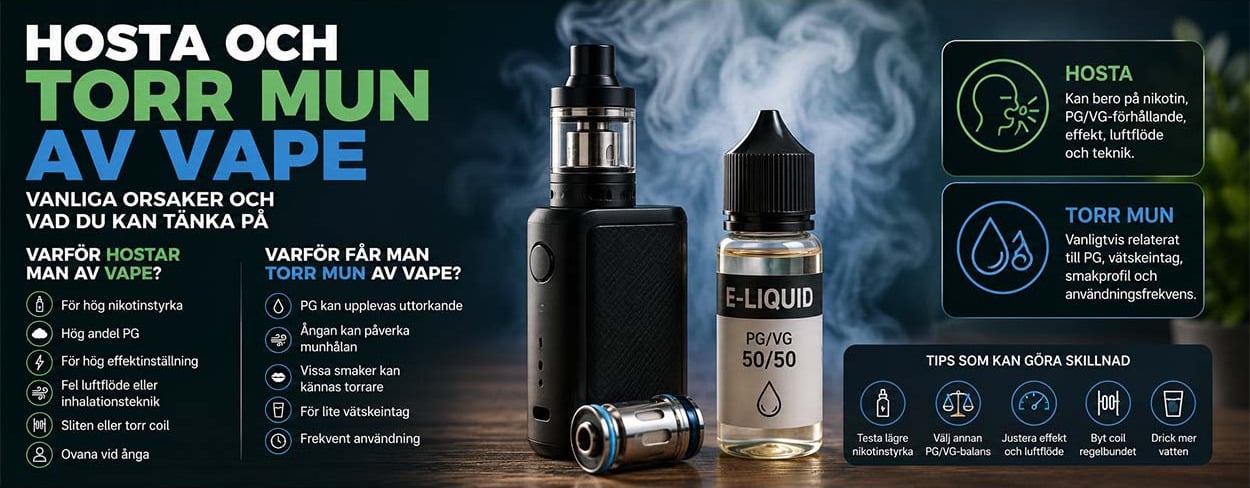
Coughing, dry mouth and throat irritation have been reported when using e-cigarettes. The aerosol can irritate the airways, but the symptoms may also have other causes. Stop using the product if coughing or irritation occurs during use.
If the symptoms began during the first use or after changing the e-liquid, coil, pod or device, the timing is important to describe when contacting healthcare services.
Can coughing occur when using a vape?
Yes. Coughing and throat irritation are reported problems when using e-cigarettes. An e-cigarette heats liquid into an aerosol; a cigarette produces smoke through combustion. Coughing is a reason to stop using the product, even when the sensation is new.
The following factors affect the liquid, aerosol or the device’s function:
- Nicotine strength: mg/ml indicates the concentration in the liquid. The inhaled dose is also affected by the amount of aerosol and puff length.
- PG content: the proportion of propylene glycol describes the composition of the liquid base.
- Power setting: watts indicate the power supplied and affect heating together with airflow and liquid delivery.
- Strong inhalation: Puff length and the amount of air can vary between uses.
- Airflow: Open and restricted airflow change draw resistance and cooling.
- First use: stop if coughing occurs. Do not try to get rid of the symptoms by taking more puffs.
- Burnt or worn coil: A change in taste and function may indicate a technical problem. A dry or burnt taste is a reason to stop activating the device.
Why can nicotine strength affect coughing?
The nicotine concentration can affect how irritating the aerosol feels in the mouth and throat. Higher concentrations have caused stronger irritation under certain tested conditions. However, the stated strength is not the same as the inhaled dose: the amount of aerosol, puff length and device also affect exposure.
The chemical form of nicotine affects the throat sensation. In controlled studies, nicotine salt has been perceived as less harsh than freebase at a comparable concentration. However, the throat sensation is not a measure of nicotine absorption or health risk.
These terms are described in our article about nicotine salt and freebase nicotine.
PG and VG can affect the sensation in the throat
PG is propylene glycol and VG is vegetable glycerin. They are used as a liquid base together with flavourings and, in nicotine-containing e-juice, nicotine. PG has a lower viscosity than VG and is also used as a carrier for flavourings. The mixture affects consistency, liquid delivery and aerosol production.
The throat sensation depends on the entire recipe and how the aerosol is produced. A thicker liquid is fed to the wick differently. The liquid’s suitability depends on the design; a higher VG content is not a treatment for coughing.
The differences are described in the article about VG/PG ratios.
Why do you get a dry mouth from vaping?
Dry mouth has been reported when vaping and may involve reduced saliva or a feeling of dryness. PG and VG can bind water, while reduced saliva can also be caused by medicines and illnesses. Dry mouth and dehydration throughout the body are different conditions.
Saliva protects the teeth, and less saliva increases the risk of cavities. Rinsing with water can provide temporary relief. In cases of recurring dry mouth, a doctor should be contacted, especially when using medication, and a dentist or dental hygienist can assess the protection of the teeth. Do not change medication on your own.
Can an incorrect power setting cause coughing?
Power affects heating and aerosol production. Excessively high power in relation to liquid delivery can overheat the wick. Nicotine and other ingredients may also contribute to irritation.
Too low a power setting can produce a weak or uneven aerosol. The coil’s wattage range indicates the intended operating range; changing the power is not a treatment for throat problems.
The technical difference is explained in the article What wattage should I vape at?.
Airflow and inhalation technique also play a role
Airflow affects draw resistance, cooling and how the aerosol mixes with air. The amount of aerosol is also affected by power, liquid delivery and design.
With MTL, mouth to lung, the aerosol is first drawn into the mouth. With DTL, inhalation goes directly to the lungs. A different design can provide different draw resistance and a different amount of aerosol. Puff length and force also affect exposure.
The definitions can be found in the guide What is the difference between MTL and DTL?.
Can a worn coil cause coughing or a dry sensation?
Deposits, inadequate liquid delivery and a heat-damaged wick can change the taste and aerosol. Stop using the device if there is a dry or burnt taste. Technical troubleshooting of the coil and assessment of coughing are separate issues.
The five signs below may indicate technical problems:
- Burnt or dry taste: Stop activating the device. Burnt cotton cannot be restored by taking more puffs or adding new liquid.
- Weaker taste: may be caused by liquid delivery, deposits or other changes.
- Less aerosol: May be caused by liquid delivery, power or other functional limitations.
- Gurgling sound: may occur when liquid is present in the air channel.
- Irregular function: stop using the device in case of damage or abnormal function, and do not test-fire it to investigate the fault.
A burnt replaceable coil should be replaced with the correct intended part. If the pod or tank section has a built-in coil, replace the entire intended part. Coil handling is described in 5 tips to avoid burnt coils. Replacement is a technical measure and does not replace an assessment of recurring symptoms.
Can certain flavours feel stronger than others?
Yes, flavourings and their concentrations can produce different sensations of cooling, sweetness or sharpness. Menthol can provide a cooling sensation and, under certain test conditions, irritation. Citrus, fruit and sweet flavour names, on the other hand, do not indicate any common contents or intensity levels.
Stop using the product if you experience problems, even if the flavour feels mild or the liquid is nicotine-free. Changing flavours should not be used to investigate the cause.
Recurring symptoms and product details
Contact healthcare services in case of recurring symptoms. Describe when they began, how often and for how long the product was used, as well as any changes in medication or fluid intake. The following product details may be helpful:
- Nicotine strength: Stated concentration in mg/ml.
- PG/VG ratio: Composition of the liquid base.
- Nicotine type: Freebase or nicotine salt in the current recipe.
- Power setting: Set power and which coil or pod was used.
- Airflow: The design’s draw resistance and any change to the airflow control.
- Device type: Differences between designs and previous product changes.
- Flavour profile: Which liquid was used and when it was changed.
When should you stop using the product or contact healthcare services?
Stop using the product if coughing or irritation occurs during use. In case of damage, abnormal heat, automatic activation or suspected liquid in the electronics, stop both use and charging. Do not charge or activate the device to test the fault.
Contact a health centre if the cough has lasted more than four weeks and does not seem to be improving. Contact a health centre or out-of-hours clinic if you have a cough and fever for more than four days or if you cough up blood.
If you have a cough with difficulty breathing or chest pain when taking a deep breath, contact a health centre or out-of-hours clinic immediately. Go to an emergency department if it is closed. Call 112 if you are coughing and have very severe difficulty breathing. Call 1177 for medical advice. The time limits are not advice to wait in the event of acute symptoms.
Quick Facts
- Reading Time
- 7 min
- Popularity
- Very Popular
- Category
- Health & research
- Published
- 2026-06-09