

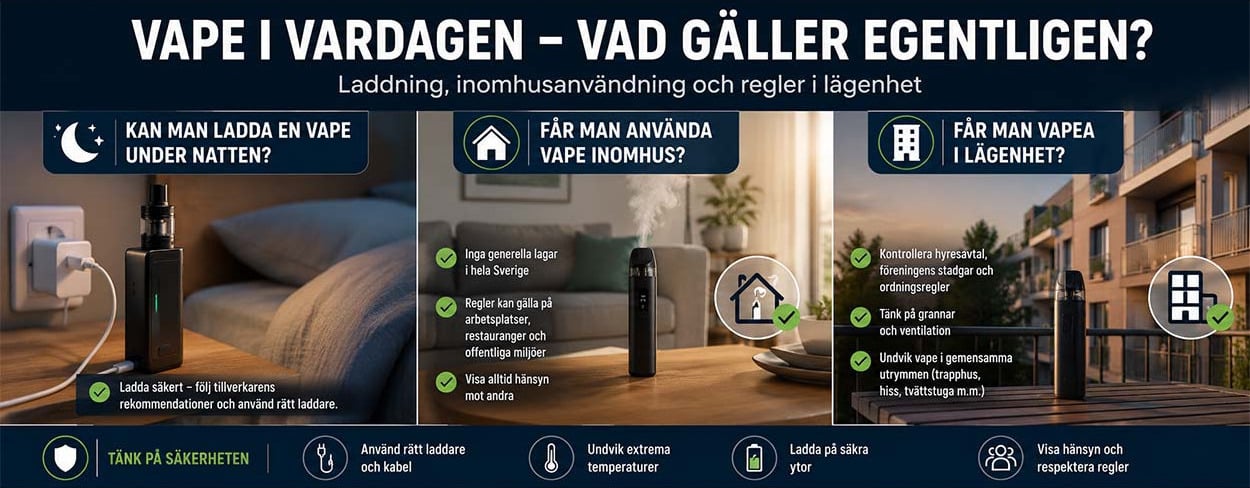
Charge a vape under supervision while you are awake, not while you sleep. E-cigarettes are covered by the smoking ban in, among other places, restaurants, shops and public transport. Permanent private residences are exempt from the statutory ban, while common areas may have their own rules of conduct.
Can you charge a vape overnight?
Do not charge it while you sleep. Charging should take place under supervision, so that you can detect and respond to faults. This also applies to devices with built-in protection circuits.
A battery fault or fault in the charging equipment can cause a fire. Unplug the device when it is fully charged.
What should you consider when charging?
Use the cable and charger intended for the device. The model's charging requirements determine which equipment and current are suitable.
- Charge on a stable, hard and heat-resistant surface away from combustible materials.
- Do not charge in bed, on the sofa or under blankets and clothes.
- Do not use damaged cables, loose connectors or a damaged battery.
- Stop charging if the device becomes unusually hot, smells strange or shows signs of damage.
Unusually slow charging is a symptom of a fault. Temperature, wear and charging habits affect the battery. Explanations about charging, heat, cold and overcharging can be found in Common problems with vape batteries.
Are you allowed to use a vape indoors?
E-cigarettes are considered smoking under the provisions on smoke-free environments. Where the law prohibits smoking, the ban also applies to vaping. The following are the main rules:
- Restaurants and cafés: smoking is prohibited in dining areas and on outdoor seating areas.
- Shops and shopping centres: smoking is prohibited in premises to which the public has access.
- Preschools, primary schools and upper-secondary schools: smoking is prohibited in premises for children and young people and in schoolyards.
- Domestic public transport: smoking is prohibited on vehicles and in areas for passengers.
- Event venues and arenas: smoking is prohibited in premises for public gatherings or public events.
- Hotels: a certain number of rooms must be smoke-free. Indoor areas generally accessible to the public are normally subject to a smoking ban.
Specially designated smoking areas are permitted in certain environments. Workplaces may also have their own rules. Universities and adult education institutions are not automatically covered by the school provision, but other smoking bans may apply to the premises.
Are you allowed to vape in an apartment or on a balcony?
The statutory smoking ban does not apply to permanent private residences, including rental apartments, tenant-owned apartments and one's own balcony. Odour and aerosol may nevertheless disturb other residents.
Tenancy terms and association rules are separate from the statutory smoking ban. A rule of conduct does not automatically constitute a legally binding ban inside the apartment or on its balcony.
What applies in common areas?
Common areas in ordinary residential buildings are not automatically covered by the statutory smoking ban. Landlords and tenant-owner associations may introduce voluntary bans in, for example, stairwells and access balconies. Rules of conduct may also cover laundry rooms, lifts, basements, storage rooms, garages and entrances.
An entrance shared with a shop or another business open to the public may be covered by the statutory ban. Do not use a vape where smoking is prohibited, and avoid exposing other residents to aerosol in common areas.
Can vaping affect neighbours?
Yes, other people may notice the smell of vape and find it disturbing. Vaping produces aerosol: small particles and droplets in the air, often called vapour. It is not merely water vapour.
Be considerate around balconies, patios, open windows and ventilation openings. Do not blow aerosol towards other people or their windows. Air the area if necessary, but ventilation does not make the air free of all substances in the aerosol. A neighbour may make a complaint even if a rule of conduct does not explicitly mention vaping.
Can fire alarms react to vape?
Yes. Aerosol from vaping can affect fire detection systems and trigger false alarms.
An activated alarm must be taken seriously. Smoke alarms and detectors must not be covered or disconnected to avoid alarms.
How should vape devices and e-liquid be stored at home?
Store the device and e-liquid out of the reach of children and pets, protected from direct sunlight and intense heat. Do not leave them in bed or among textiles while charging.
A cracked pod, leaking tank or damaged battery is reason to stop using it. Storage and temperature requirements vary between products; the manufacturer's instructions apply to the specific model.
Here you can find our range of vape.
Quick Facts
- Reading Time
- 4 min
- Popularity
- Very Popular
- Category
- Vape
- Published
- 2026-06-12