

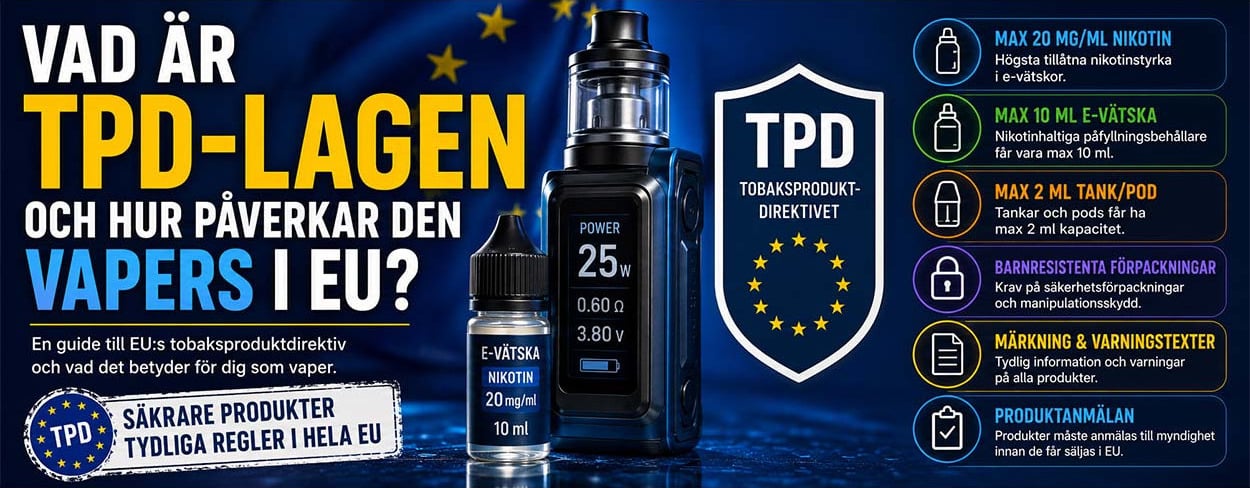
TPD is the EU Tobacco Products Directive, Directive 2014/40/EU. Article 20 contains requirements for e-cigarettes and nicotine-containing refill containers. The requirements include nicotine content, liquid volume, labeling, child safety and product notification.
The directive is implemented in the legislation of the Member States. Therefore, the common EU requirements need to be distinguished from national sales regulations. For vape products in Sweden, Swedish rules also apply, including rules on age verification and marketing.
What does TPD mean?
The directive covers, among other things, cigarettes and roll-your-own tobacco, with specific provisions for e-cigarettes and nicotine-containing refill containers.
TPD is an EU directive that Member States implement through national provisions. It is therefore not a single directly applicable sales law for every nicotine product. Tobacco-free nicotine products and nicotine-free liquids are not automatically subject to the same rules as nicotine-containing refill containers.
An e-cigarette is defined as a product that can be used for the consumption of nicotine aerosol through a mouthpiece. The definition also covers components such as tanks, cartridges and devices without a tank or cartridge. Empty hardware or use with nicotine-free liquid therefore does not automatically make such a product exempt.
Sweden, Germany and France are based on the same directive, but language requirements, sales conditions and other national provisions may differ. Medicinal products and medical devices covered by their specific regulatory frameworks are handled separately; an ordinary e-cigarette does not receive such exemptions merely through a claim of medical use.
Why do TPD regulations exist?
The directive is intended to harmonize Member States’ rules for tobacco products and related products while also ensuring a high level of protection for human health. For e-cigarettes, this entails specific requirements in six areas:
- Product requirements: Including limits on nicotine content and volume, as well as requirements concerning ingredients and product function.
- Labeling and consumer information: Ingredient declaration, health warning and accompanying leaflet.
- Ingredient reporting: Information about ingredients, emissions and toxicology in the product notification.
- Product notification: The manufacturer’s or importer’s details are submitted before the product is introduced to the market.
- Child resistance: Requirements for protection intended to prevent children from accessing the product and liquid.
- Common foundation: Member States implement the directive’s requirements in their national regulatory frameworks.
Maximum 20 mg/ml nicotine
Nicotine-containing e-liquid covered by Article 20 may contain no more than 20 mg of nicotine per milliliter. The limit applies to the concentration in the liquid, not the amount of nicotine a person inhales or absorbs into the body.
The same concentration limit applies to nicotine salt and freebase nicotine. The form of the nicotine does not provide a separate exemption from the limit, and 20 mg/ml is a legal maximum, not a recommended strength.
Maximum 10 ml for nicotine-containing e-liquid
A refill container with nicotine-containing liquid for e-cigarettes may hold no more than 10 ml. Smaller containers are also possible; the rule does not require every bottle to contain exactly 10 ml.
Nicotine-free shortfill is not covered by this limit for nicotine-containing refill containers. Other product and chemical regulations may still apply. What matters here is the nicotine content and the product’s legal category, not whether the nicotine is salt or freebase.
The format issue is also addressed in the article about why nicotine salt is sold in small bottles and shortfills in larger ones.
Maximum 2 ml tanks and pods
Article 20 states that nicotine-containing liquid may be supplied in refill containers, disposable e-cigarettes or disposable cartridges. Tanks and cartridges covered by the provision may hold no more than 2 ml. A pod that is such a cartridge is subject to the same limit.
This is a different volume rule from the 10 ml limit for the refill container. It should not be applied to every nicotine-free liquid bottle. A tank intended for nicotine aerosol is not automatically exempt because it is supplied empty.
The volume requirements may explain why a product is available in different versions for the EU and other markets. A larger international version does not automatically meet the requirements for sale in Sweden.
Labeling and warning text requirements
For the e-cigarettes and refill containers concerned, the packaging must include an ingredient declaration and health warning, as well as an accompanying leaflet. The labeling must state, among other things, the ingredients in descending order by weight, nicotine content and delivery per dose, batch number and an instruction to keep the product out of reach of children.
The leaflet must contain information about use and storage, contraindications, specific risk groups, possible adverse effects, addictive properties and toxicity, as well as contact details. Packaging labeling and the leaflet are therefore separate parts of the requirements.
The prescribed Swedish nicotine warning reads: “This product contains nicotine, which is a highly addictive substance.” The warning must appear on the unit packaging and any outer packaging in accordance with applicable labeling rules. The fact that the countries are based on the same directive does not mean that the language and all details are identical.
Child resistance, tamper protection and leakage requirements
E-cigarettes and refill containers must meet requirements for child and tamper resistance, as well as protection against damage and leakage. The refill mechanism must prevent leakage. Child resistance does not mean that it is impossible for a child to open a package.
The requirements are intended to prevent accidental exposure, but they do not replace storage out of the reach of children. A damaged or leaking product should not be used. The technical meaning is described in the article about what childproof means.
The requirement for consistent nicotine delivery applies to normal use. It does not mean that every user inhales or absorbs the same dose.
Product notification before sale
Manufacturers and importers must notify the relevant products to the competent authority in the country where they are to be introduced. In Sweden, the notification must be submitted to the Public Health Agency of Sweden at least six months before the product is made available on the consumer market. EU-CEG is used for the electronic transmission of product information. A significant product change requires a new notification.
Depending on the product, the documentation includes ingredients and emissions, toxicological information, including after heating, nicotine dose and absorption, components, technical specifications and the manufacturing process. Companies are responsible for ensuring that the requirements are met.
A notification is not an approval by the authorities or a pre-market inspection of every product. The fact that a product appears on a list does not prove that all requirements have been met.
The six-month period may affect the launch time, but does not automatically explain every delay. Notifications and other processes are discussed in the article about why new vape products sometimes take time to reach the Swedish market.
How does TPD affect Swedish vapers?
In Sweden, the requirements are implemented, among other things, through the Act on Tobacco and Similar Products, the associated ordinance and agency regulations. This establishes rules concerning which products concerned may be made available, their volume and nicotine content, as well as labeling and safety features.
Swedish law prohibits the sale and supply in commercial activities of e-cigarettes and refill containers to persons under 18 years of age. Age verification also applies to distance sales. The age limit follows Swedish law.
Sweden also has specific restrictions on the marketing of e-cigarettes and refill containers. Product notification does not provide general permission to market the product.
Where can you read more about TPD?
EU legal acts and information from the Public Health Agency of Sweden describe different parts of the regulatory framework:
- The EU Tobacco Products Directive on EUR-Lex: Directive 2014/40/EU contains product definitions and Article 20’s requirements for e-cigarettes and refill containers.
- The Public Health Agency of Sweden: The information about e-cigarettes and refill containers describes Swedish implementation, product notification, labeling and sales requirements.
Swedish provisions implement the directive and supplement the common EU requirements.
The following nicotine warning concerns nicotine-containing liquid. The age limit applies to the sale and supply in commercial activities of e-cigarettes and refill containers in Sweden:
Contains nicotine, which is a highly addictive substance. Age limit 18.

Quick Facts
- Reading Time
- 7 min
- Popularity
- Very Popular
- Category
- Rules & travel
- Published
- 2026-06-04