

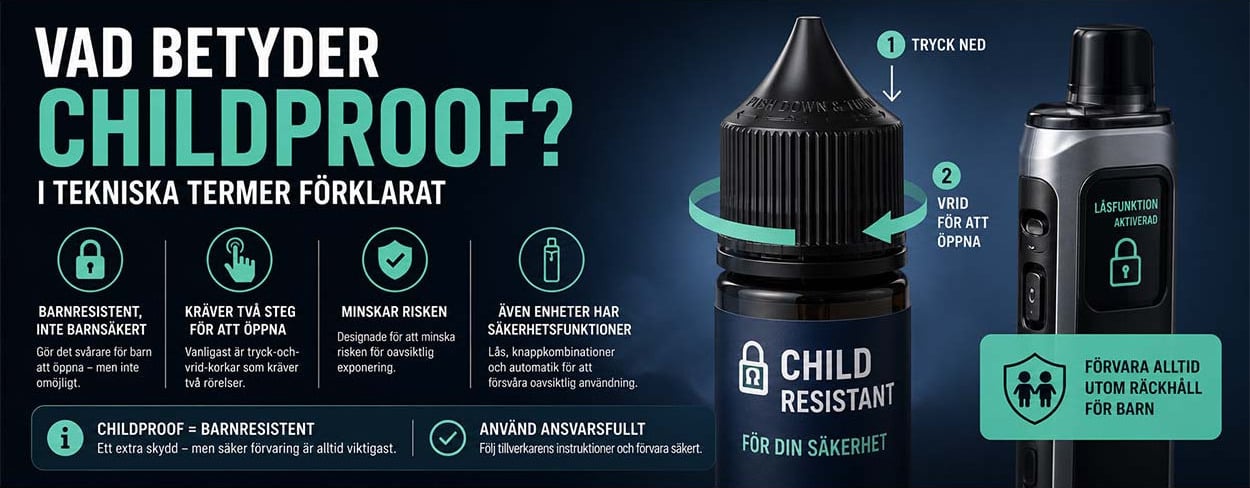
Childproof is used for protection intended to make access more difficult for children. For packaging, the more precise term is child-resistant: young children should have greater difficulty opening the packaging, while adults should still be able to use it.
What does child-resistant mean?
Child resistance is assessed for a specific packaging design using specified test methods. The protection makes opening more difficult but does not prevent every child from opening it. Therefore, keep the product out of sight and reach even with the cap closed.
For vapes, the packaging protection must be distinguished from the device’s electronic lock.
Why is the protection used?
Child-resistant packaging is intended to prevent access to harmful contents such as nicotine, medicines and chemicals.
Swedish e-cigarette regulations require child-resistant and tamper-resistant protection, as well as protection against damage and leakage, for relevant products. For other chemical products, CLP classification may require a child-resistant closure. Nicotine-free e-juice is also covered by chemical regulations, but the requirements depend on the contents.
How does a push-and-turn cap work?
In a two-part design, pressing down can connect the outer cap section to the inner threaded section.
- Press down the cap.
- At the same time, turn it in the opening direction indicated on the packaging.
Other child-resistant closures use, for example, locking catches or sliding mechanisms. The mechanism varies between packages.
Which product groups have such protection?
- E-liquids and nicotine products: requirements depend on the category and contents.
- Medicines: testing is adapted to the type of packaging.
- Cleaning products: classification may result in requirements for a child-resistant closure.
- Other chemicals: CLP determines specific packaging requirements.
- Battery-powered products: an electronic lock and protected battery compartment are separate functions from tested child resistance.
- Refill containers: relevant nicotine-containing containers are covered by the e-cigarette regulations’ protection requirements, including those with nicotine salt.
Is a device lock child-resistant?
A button sequence can control activation or locking, but is not in itself a child-resistance test. A settings lock may still leave activation possible. Sleep mode and automatic shutoff control operation; packaging testing is assessed separately.
Is child-resistant the same as childproof?
No. Child-resistant means that access is made more difficult. The packaging must not be left accessible to children, regardless of the cap or electronic lock.
What can impair the protection?
Damage, wear and incorrect resealing can affect the mechanism. The closure is designed for its intended container. Another lid or another bottle is not automatically equivalent. Appearance or a click does not determine whether the protection works.
Which standards apply to different packages?
ISO 8317:2015 specifies requirements and test methods for reclosable child-resistant packaging, including assessment of both children’s access and adults’ use.
EN ISO 14375:2023 applies to non-reclosable pharmaceutical packaging. EN ISO 28862:2023 applies to non-reclosable packaging for other products.
The standards concern the correct type and design of packaging, not ongoing inspection of every individual item or official approval of the product. At the same time, legal requirements depend on the country and product category.
How should the packaging be handled?
- Keep e-liquids and e-cigarettes out of sight and reach of children and pets.
- Do not leave an opened liquid bottle accessible or unattended.
- Fully close the original cap to its intended position after handling.
- Take a broken or worn closure out of use. Do not pour the liquid into another container to replace the protection.
- Keep the liquid in the original packaging and use the closure’s intended movement.
The warning below applies to nicotine-containing liquid. The age limit applies to sales and distribution in commercial operations in Sweden:
Contains nicotine, which is a highly addictive substance. Age limit 18 years.

Quick Facts
- Reading Time
- 3 min
- Popularity
- Very Popular
- Category
- Rules & travel
- Published
- 2026-06-03