

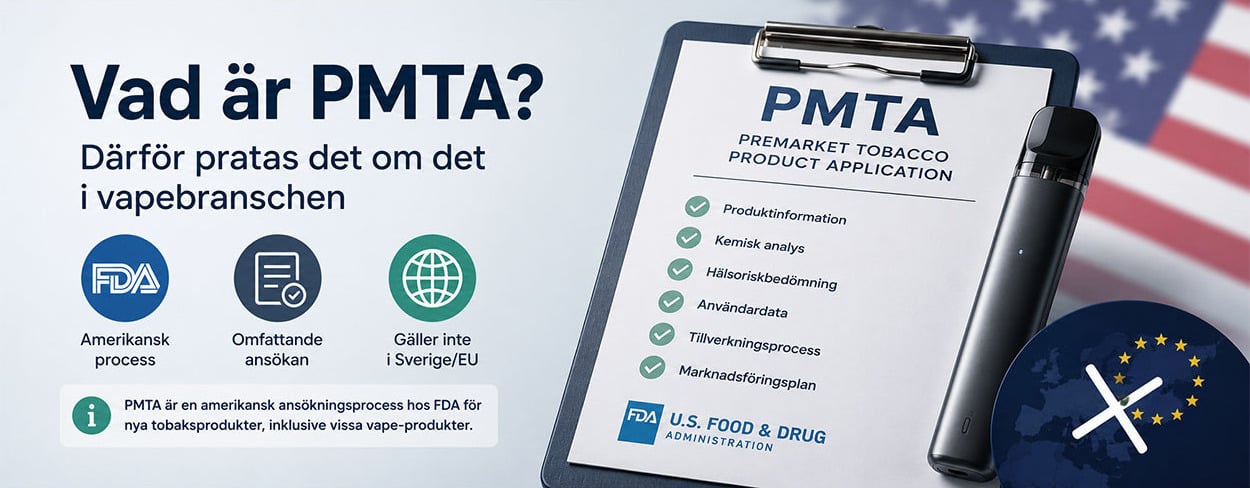
PMTA stands for Premarket Tobacco Product Application. It is an application to the U.S. FDA for the marketing of a new tobacco product, including vape products. The application is reviewed before the authority decides whether to grant or deny authorization.
The term appears in international industry news and manufacturer information because the FDA’s decisions affect which products may be marketed in the United States. An application, an ongoing review and an issued authorization describe different stages.
What does PMTA mean?
PMTA means Premarket Tobacco Product Application. The application is submitted to the Food and Drug Administration (FDA), the U.S. authority that regulates, among other things, tobacco products. PMTA is one of the authority’s pathways for reviewing new tobacco products before marketing in the United States.
The product category also includes electronic cigarettes, such as prefilled pod kits, disposable vapes and other products classified as tobacco products under U.S. law. Nicotine from both tobacco and synthetic sources falls under the FDA’s authority.
The submission includes, among other things, information about the product’s contents, design, manufacturing, laboratory testing and scientific data. The FDA uses the information to assess the product covered by the application.
Why does PMTA exist and what is its purpose?
The purpose is to enable the FDA to assess whether marketing a new tobacco product is appropriate for protecting public health. The review considers the population as a whole, including both people who use tobacco products and people who do not.
The FDA assesses, among other things, the likelihood that current users will stop using tobacco products and that non-users will start. The product’s contents, manufacturing, use and risks are included in the submission. This public health criterion does not mean that the product is considered risk-free for the individual user.
Why is PMTA being discussed in the vape industry?
FDA decisions affect manufacturers’ ability to market products in the United States. Consequently, applications and decisions are also significant in international news about e-cigarettes, pod systems, disposable vapes and flavored products.
A positive decision following the PMTA review is called a Marketing Granted Order (MGO). It permits the marketing of the specified products under the conditions of the decision. The authorization does not automatically apply to an entire brand or all of its flavors and variants.
A Marketing Denial Order (MDO) denies marketing of the products covered by the decision. Such a decision may be temporarily suspended during further review, as explained in the section on denials.
Does PMTA mean that a vape is safe?
No. Neither a PMTA application nor a marketing authorization from the FDA means that the product is safe or risk-free. The FDA does not describe such an authorization as meaning that the tobacco product is ”FDA approved”.
Tobacco product review uses a public health criterion. Medicines are reviewed according to different requirements for safety and efficacy. An MGO does not automatically grant the right to make claims about reduced health risks.
Does PMTA apply in Sweden and what is the difference from TPD?
No. PMTA applies to the review of new tobacco products before marketing in the United States. TPD is the EU Tobacco Products Directive, which is implemented in Swedish legislation together with national rules concerning, among other things, sales and marketing.
For e-cigarettes and nicotine-containing refill containers covered by the rules, manufacturers and importers must notify the product to the Public Health Agency of Sweden via EU-CEG at least six months before market introduction. Product notification is not a pre-market inspection or product approval by the authority.
The product must comply with Swedish product, labeling and sales requirements.
The scope of the rules differs between e-cigarettes, nicotine-containing refill containers and nicotine-free e-juice. The requirements for nicotine-containing refill containers do not automatically apply in the same way to every nicotine-free bottle.
The guide What is the TPD law and how does it affect vapers in the EU? covers the EU rules. PMTA and TPD belong to different regulatory frameworks and entail different obligations.
Why do some manufacturers mention PMTA?
Manufacturers operating in the U.S. market may refer to PMTA to describe that an application has been submitted, is under review or has resulted in a decision. These statements have different meanings.
An accepted application has been registered with the FDA. ”Submitted” means sent in, and ”pending” means that the matter is awaiting a decision. An MGO specifies which products may be marketed and under what conditions.
Denials, costs and nicotine-free components
A denial prohibits marketing in the United States. There is no application fee for an application to the FDA, but preparing the documentation and conducting tests costs money. Nicotine-free functional parts may also be covered by the system.
What happens if a PMTA is denied?
An MDO denies marketing of the products covered by the decision in the United States. The FDA or a court may temporarily suspend the effect of the decision during further review, a so-called stay. An appeal in itself does not mean that the decision has been suspended, and a stay is not an MGO.
A U.S. denial does not automatically determine whether the product may be sold in Sweden or other EU countries. There, sales are assessed under the respective regulatory framework.
How much does a PMTA application cost?
The FDA’s application fee for an ENDS PMTA is USD 0. ENDS means Electronic Nicotine Delivery Systems, the U.S. term for, among other things, e-cigarettes. The company’s costs for preparing the application are additional.
The work may include laboratory testing, product and manufacturing documentation, scientific studies and regulatory work. The cost depends on the product and the scope of the work.
Does PMTA also apply to nicotine-free vape products?
Yes, certain nicotine-free products may be covered as parts or components of an FDA-regulated system. Examples include tanks, coils and nicotine-free liquid intended or reasonably expected to be used together with a regulated nicotine product.
Functional parts are distinguished from accessories such as lanyards. Intended or reasonably expected use determines whether a nicotine-free product is covered.
Synthetic nicotine is not nicotine-free. Since the 2022 legislative amendment, the FDA’s authority covers nicotine from all sources, including when it does not come from tobacco.
Quick Facts
- Reading Time
- 6 min
- Popularity
- Very Popular
- Category
- Rules & travel
- Published
- 2026-07-06