

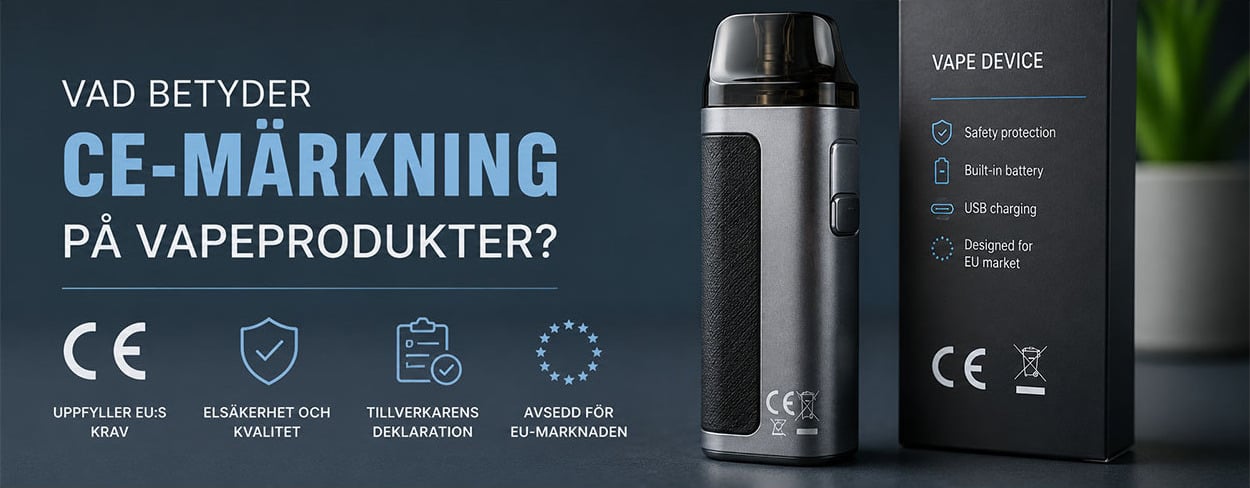
CE marking is the manufacturer's declaration that the product meets the applicable EU legislation requiring the marking. It is the manufacturer who is responsible for the assessment, not an EU approval of each product.
For an electric vape, the finished device is assessed. The battery and separate power adapter may be subject to their own requirements. For e-juice, nicotine and sales, there are also specific rules.
What is CE marking?
CE is a marking for product groups covered by EU legislation requiring CE marking. It is used within the EU and EEA and means that the manufacturer assumes responsibility for the product's conformity with the applicable requirements.
The manufacturer must carry out the required assessment, have technical documentation and draw up an EU declaration of conformity. An authorised representative may perform certain tasks according to its mandate, but the manufacturer's responsibility for the product remains.
The EU declaration identifies, among other things, the product by model or type, the manufacturer and the legislation to which the assessment relates. It is signed by a responsible person. The CE mark is not a mark of origin and does not mean that the product was manufactured in the EU.
Why is CE marking found on vape products?
Electric vape devices may be covered by EU rules for electrical and electronic equipment. The design may include a battery, charging port, circuit board, display and sensors that control heating and other functions.
For such e-cigarettes, the manufacturer must assess the conformity of the finished device. This applies to both pod systems and other rechargeable designs when they are subject to CE requirements.
The finished weapon is assessed as a whole. The battery and power adapter may have their own CE requirements depending on the component's role and the applicable legislation.
What requirements may CE marking cover?
For electrical and electronic equipment, rules on electromagnetic compatibility, EMC, and the restriction of certain substances, RoHS, may apply. EMC concerns electromagnetic interference and the equipment's immunity to such interference. RoHS restricts certain substances in the equipment.
A product with a radio function may be covered by the Radio Equipment Directive, RED, which includes requirements for safety, electromagnetic compatibility and the use of the radio spectrum. A display or USB port does not in itself mean that a vape has a radio function.
The Low Voltage Directive, LVD, applies to equipment designed for rated voltages of 50–1000 volts alternating current or 75–1500 volts direct current. A battery- or USB-powered vape is therefore not automatically covered by the LVD. A separate power adapter with mains voltage may, however, be covered. The fact that a product falls outside the LVD's voltage range does not mean that it has no safety requirements.
Which legal acts apply is determined by the product's design and function. The assessment needs to cover, among other things, charging, components and intended use. Nicotine content, the contents of the e-liquid, health warnings and the age limit are regulated separately.
Does CE marking mean that the product is approved by the EU?
No. CE marking is the manufacturer's declaration of conformity, not product approval from the EU or an authority.
In some conformity assessment procedures, a notified body must be involved. In others, the manufacturer may carry out the assessment using its own documentation in accordance with the applicable legislation. The involvement of a notified body does not change the manufacturer's responsibility.
Other product and sales requirements apply in parallel with the CE rules.
How do you find the CE marking on a vape?
The general rule is that the CE mark must be visible, legible and permanent on the product or its type plate. Packaging and accompanying documents may replace placement on the product only when the applicable legislation allows it, for example when the nature of the product makes product marking impossible or inappropriate.
The placement and any supplementary marking are governed by the applicable legal act.
The mark must refer to the correct product. The model or type designation links the device to its EU declaration and documentation. Do not open a sealed vape or an integrated battery device to look for marking on built-in parts.
CE marking and batteries in vape products
Batteries are covered by the EU Batteries Regulation 2023/1542. The obligations regarding conformity assessment, the EU declaration and CE marking have applied since 18 August 2024. Later requirements, such as removability, have their own application dates.
The charging port, input conditions and electronic protections are part of the device's design. The charger and cable must be suitable for its specified voltage, current and charging support.
For rechargeable devices, including e-cigarette starter kits, the charging equipment must be intended for the device's charging conditions. USB charging alone does not indicate which protocols, voltages or currents the device supports.
Charge when you are awake and supervising, in a dry environment and without extreme temperatures. Do not use or charge a damaged, swollen, abnormally hot or self-activating device, or a device suspected of having liquid in its electronics. Do not test the fault by attempting to charge or activate it.
CE marking and other requirements for vape products
CE marking of an electronic device does not replace the requirements for e-cigarettes, nicotine-containing refill containers and sales. Product notification, content declaration, labelling, health warnings and age limits belong to other regulatory areas.
An e-cigarette for nicotine aerosol may be subject to both CE requirements and specific e-cigarette rules. The e-liquid has its own content and labelling requirements.
Product notification to the Public Health Agency of Sweden is not approval by an authority. Nicotine-containing refill containers and nicotine-free liquids are not automatically subject to the same detailed requirements.
Why is CE marking relevant to the consumer?
The marking shows that the manufacturer declares conformity with the applicable CE requirements for the identified product. The EU declaration describes which product and legislation the assessment concerns, while the technical documentation must support that assessment.
Quick Facts
- Reading Time
- 5 min
- Popularity
- Popular
- Category
- Rules & travel
- Published
- 2026-06-24