

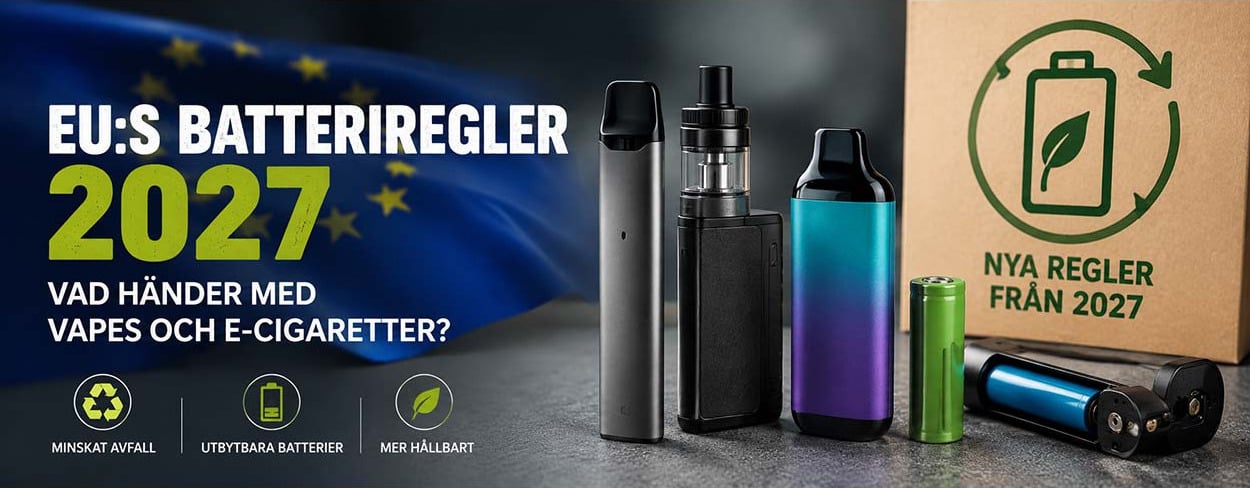
From 18 February 2027, specific requirements for removable and replaceable batteries will begin to apply. For products with portable batteries, the general rule in Article 11 is that the end-user must be able to remove and replace the battery. There are conditional exceptions. A replaceable pod is not the same thing as a replaceable battery.
The EU Batteries Regulation 2023/1542 covers batteries in many product categories, including vapes. Mobile phones and tablets also have their own ecodesign rules, so their battery solutions and exceptions cannot be directly transferred to e-cigarettes.
What do the EU’s new battery rules mean?
The Batteries Regulation regulates, among other things, battery design, producer responsibility, collection and recycling. It entered into force on 17 August 2023 and is being applied in stages. The entire regulation therefore does not start to apply in 2027.
Manufacturers’ obligations regarding conformity assessment, the EU declaration and CE marking for batteries have applied since 18 August 2024. The new producer responsibility rules have applied since 18 August 2025. Article 11 on the removal and replacement of relevant batteries starts to apply on 18 February 2027.
The purpose includes reducing waste and improving the management of batteries throughout their life cycle. When an integrated battery wears out, other parts of the device may still function. The possibility of replacing the battery is a design issue that differs from how the battery is collected for recycling.
Under the general rule, the battery must be removable using commercially available tools. Special tools may be required if they are provided free of charge, but disassembly must not require proprietary tools, heat or solvents. The product must have understandable instructions and safety information about use, removal and replacement, also available online.
Do the rules also apply to vapes?
Yes, batteries are not exempt from the Batteries Regulation because they are located in a vape. Article 11’s general rule applies to portable batteries incorporated into products. The European Commission’s guidance from 2026 explicitly mentions e-cigarettes.
The requirement for removal and replacement concerns the battery as a whole, not the user’s ability to replace every cell in a battery pack. Rechargeability, a compact casing or a replaceable pod does not demonstrate that the battery design meets the requirements.
Certain exceptions may allow replacement by an independent professional instead of the end-user. This applies, among other things, to certain appliances intended for wet environments and washing or rinsing, where this is necessary for safety, as well as certain professional medical devices. An IP rating or a water-resistant casing alone does not provide an exception.
There is also a specific exception when continuous power and a permanent battery connection are necessary for safety or data integrity in products whose main function is to collect and provide data. This is not a general exception for sealed vapes. Compliance for a particular model cannot be determined solely from the product category.
Battery requirements and the design of disposable vapes
A disposable vape is intended to reach the end of its service life when its liquid or function has been used up. It may contain a lithium-ion battery even when the entire device is to be sent for recycling. Some disposable designs are rechargeable; this does not automatically make them refillable or battery-replaceable.
For a design covered by Article 11, access to and replacement of the battery must meet the applicable requirements. The fact that the device is intended for limited use does not provide any specific general exception to the basic rule.
The regulation’s objectives are to reduce waste, recover resources and improve battery recycling.
Do the rules constitute a ban on disposable vapes?
No, Article 11 is not an explicit general category ban on disposable vapes. It imposes design requirements on products with batteries that fall within its scope.
Products placed on the market must meet the applicable design requirements. Other product, nicotine and sales regulations also apply.
Manufacturers may need to change the battery’s attachment, access or replacement solution.
A replaceable pod and a replaceable battery are different features
In a pod system, the same battery unit may be used while the pod is refilled or replaced. The battery may still be integrated. Replacing the pod therefore does not show that the user can remove and replace the battery.
This also applies to prefilled pod kits. A replaceable container, reuse of the battery section and a user-replaceable battery are three different design features.
Upcoming design requirements do not mean that today’s sealed or integrated devices should be opened. Only remove an undamaged, cooled battery section through a design intended for user replacement, with the device switched off and the charging cable disconnected. Do not break, puncture or modify an integrated device.
Which battery requirements begin to apply in 2027?
On 18 February 2027, Article 11’s requirements for removal and replacement will begin to apply. For products covered by the general rule, the end-user must be able to replace the battery with a compatible battery without impairing the product’s function, performance or safety.
Replacement batteries must be available for at least five years after the last unit of the equipment model has been placed on the market, at a reasonable and non-discriminatory price. The battery must be compatible with the equipment.
Manufacturers need to design access, attachment and the replacement solution according to the requirement applicable to the product. Where an exception allows replacement by an independent professional, this is not the same as unrestricted user access.
Today’s worn-out integrated device should be left intact as electrical waste when the battery is not intended to be removed. Do not use or charge a damaged, swollen, abnormally hot or self-activating device, or a device with suspected liquid in the electronics. Do not test a fault by attempting to charge or activate it.
Quick Facts
- Reading Time
- 5 min
- Popularity
- Very Popular
- Category
- Rules & travel
- Published
- 2026-06-17